A signature identifies a publisher. What may the tool do?
ToolCapsule
Run a signed tool within explicit trust and resource boundaries. Inspect how package admission, constrained WASI execution and replay receipts answer separate questions.
Experimental pure WASI 0.2 transformations. No independent security audit, hosted authentication or managed tenant isolation. Compilation and total process memory need external worker limits.
Latest verified change · PR #3 ↗ · Merged
Signed admission, bounded execution, inspectable replay
PR #3 integrates the package, runtime and adapter slices. Integrated-main CI passed on Windows, Linux and macOS. The website reviewed public source and validation records; it did not execute the runtime or perform a security audit.
Verified · PR #3 · d42dbbd3af2d
Source checked . Documentation and retained evidence review, not a new runtime test.
Read change evidence ↗Professional relevance
Useful for designing state ownership, recovery and inspectable interfaces. These examples make failure behavior and authority explicit.
Explore the engineering background →Derived architecture / Experimental WASI 0.2 MVP
Inspect the authority at each boundary.
Follow a pure transformation from signed package to replay evidence. Open each boundary to see what is enforced and what remains the integrator's responsibility. No tool executes in this website.
Verify identityTrusted key and exact component bytes.
Ed25519 signatures and SHA-256 bind publisher identity and package content. The trust store comes through an operator-trusted channel. A valid signature does not establish safety.
Read the sourceAuthorize policyDeny by default; reject unsupported grants.
Tool allowlists and host limits constrain admission. Manifest fields cannot create authority. The pure transformation profile exposes no host files, inherited environment, sockets, secrets or subprocess APIs.
Read the sourceBound the guestFuel, memory, deadline and I/O.
Fresh guest state and declared budgets bound execution. Compilation and total process memory are outside those controls. Separately constrained OS workers remain necessary for untrusted publishers.
Read the sourceVerify the replayExact inputs and digests, separate correctness.
Replay checks successful re-execution with the same package, input, seed and engine profile. Timing-sensitive guests can mismatch. Audit chains require an externally trusted earlier head; guest output remains untrusted data.
Read the source
Integrated-main CI / three operating systems
CI at d42dbbd passed Windows, Linux and macOS. The source validation record reports 16 tests after the MCP error-ID regression correction. This is upstream test evidence, not an independent security audit or a fresh website execution.
Inspect upstream evidenceExperimental pure transformations only. Authentication, queue admission, tenant quotas, JIT/process limits and durable audit storage belong to the integrating service. No independently audited multi-tenant security boundary or production deployment is claimed.
Can an AI tool be trusted just because its code is signed? →Documented example / 18 October 2026
A signed package crosses separate trust boundaries.
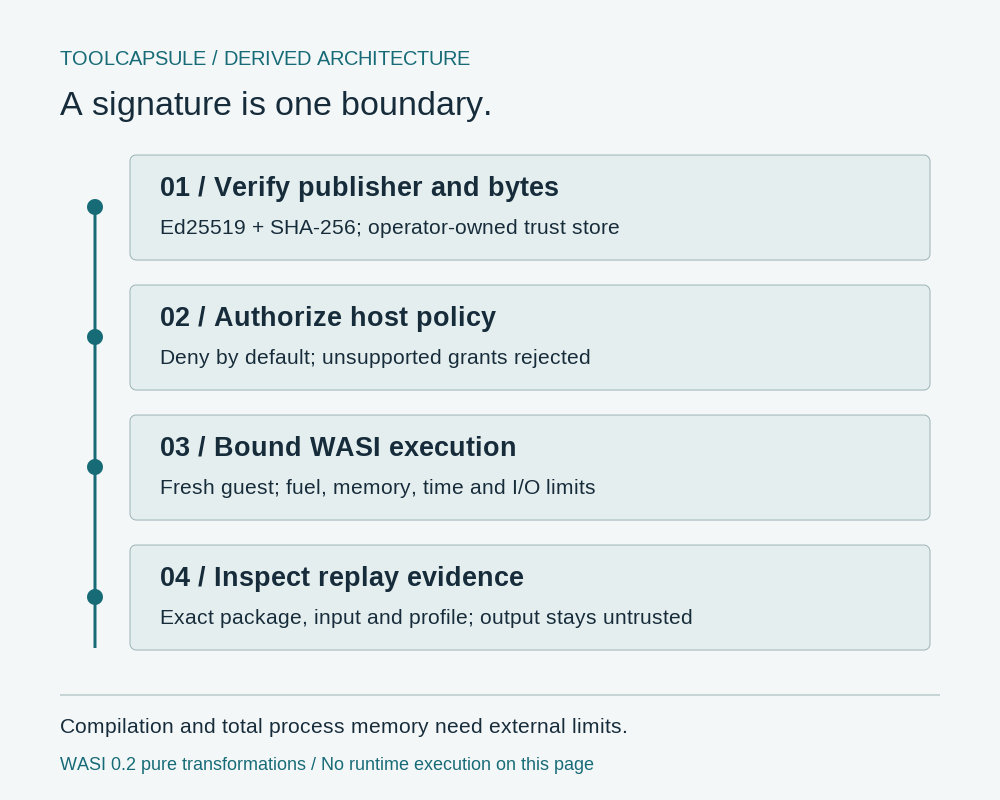
Follow the documented pure-transformation contract. This derived diagram describes the implementation; it is not a captured invocation.
Which decision does each boundary establish?
Identity, authority and evidence answer separate questions.
No ToolCapsule runtime was executed for this page. The diagram adds no benchmark or security assurance. Compilation and process limits belong to the integrator.
In plain terms
The documented uppercase demo admits a signed WebAssembly component, transforms its input and verifies a replay receipt. It supplies no guest filesystem or network access.
Why it matters
Publisher identity, permitted behavior and execution evidence need separate checks. Keeping them explicit makes an automated action easier to inspect.
Follow the example, step by step
Admit the package
Verify Ed25519 identity and SHA-256 bytes against an operator-owned trust store and deny-by-default policy.
Bound execution
Apply guest fuel, memory, time and I/O limits. Unsupported capability grants are rejected.
Inspect the receipt
Retain digests and verify re-execution with the exact package, input, seed and engine profile.
Separate signed identity from execution authority
Documented approach
Use an operator-owned trust store and deny-by-default host policy before preparing a pure WASI transformation.
Alternative and scope
Accepting any signed package as authorized would let publisher identity stand in for a host capability decision.
Cost of the choice
The narrow profile excludes external capabilities. Guest budgets do not constrain compilation or total process memory; separate OS worker limits are required.
What the evidence establishes
The upstream validation record reports 16 tests after the MCP correction. Integrated-main Windows, Linux and macOS CI passed; no independent security audit is claimed.
Read the decision source (opens in a new tab)Identity, authority, execution evidence
Derived architecture for the experimental pure WASI 0.2 profile. No runtime trace or production security assurance is implied.
Identity is an admission input
An operator-selected trust store maps signing keys to publishers. A signed manifest binds component bytes and declared limits. Policy starts by denying every tool; package metadata cannot grant host authority.
The CLI checks trust and policy before execution preparation. Compilation and interface validation happen later. A signature does not establish that a program is safe or that its result is correct.
A deliberately narrow execution profile
The MVP supplies no filesystem preopens, inherited environment, sockets, secrets or subprocess APIs. Each invocation receives fresh guest state. Fixed clocks and seeded random bytes are deterministic fixtures, not a cryptographic entropy service.
The default signed profile allows 10 million fuel, 64 MiB guest memory, one second and 64 KiB each for input, stdout and stderr. Host policy rejects excessive requests rather than silently reducing them. Guest output remains untrusted, including possible prompt injection.
Receipts preserve evidence with limits
Receipts retain digests instead of raw input and output. Replay re-executes successful runs against the same package, input, seed and engine profile. Host scheduling can still cause timing-sensitive guests to fail replay.
The local audit hash chain detects changes only relative to a trusted earlier head. It is not signed or externally anchored. Authentication, tenant admission, compilation limits, total process memory and durable audit retention belong to the integrating service.
Related writing
Inspect the checked source
Evidence reviewed . Individual decisions and captured examples retain their own source revisions and limitations.
Read the checked README (opens in a new tab)