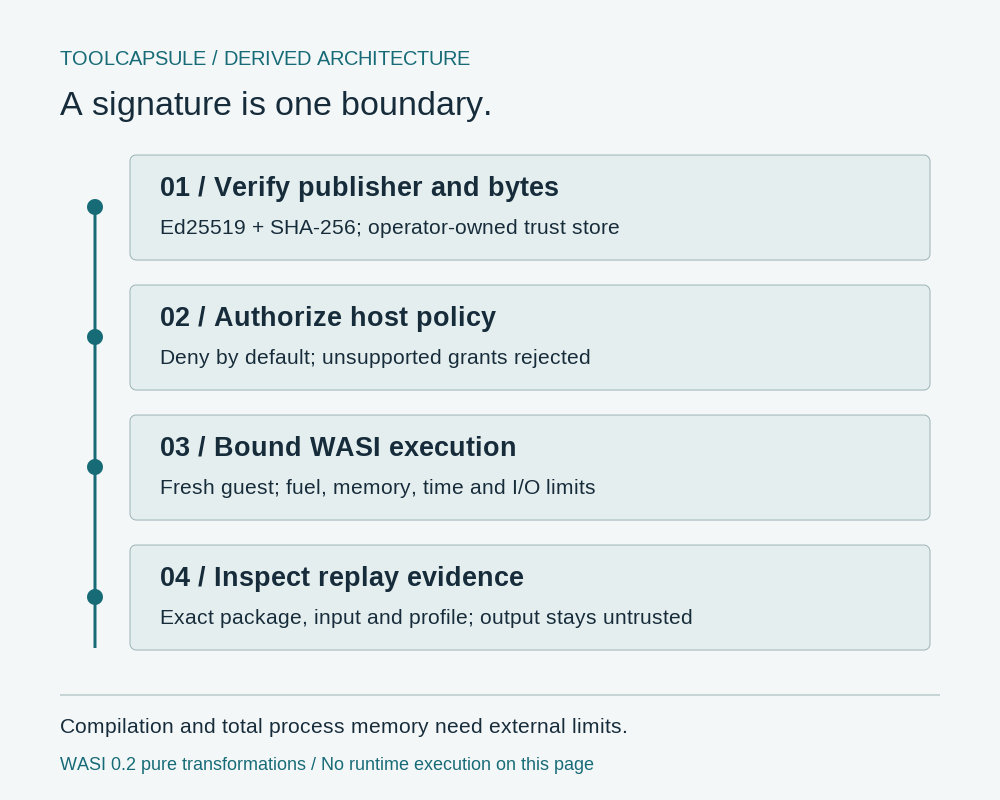
Can an AI Tool Be Trusted Just Because Its Code Is Signed?
ToolCapsule separates publisher identity, capability policy, guest resource limits and replay evidence. A signature is one admission check, not a safety or correctness result.
Read articleEngineering writing
Articles about architecture, implementation, and applied intelligence across interfaces where systems must agree.
On this website
Follow writing and engineering notes
Add this feed to your RSS reader to follow new articles and engineering notes. No signup or tracking on this site.
Follow via RSSToolCapsule separates publisher identity, capability policy, guest resource limits and replay evidence. A signature is one admission check, not a safety or correctness result.
Read articleRestoring bytes and references does not authorize new work. SimWeave's local maintenance workflow makes pause, drain, verification and explicit resumption separate decisions.
Read articleA recovery drill must preserve the relationship between jobs, recorded bytes and review decisions. SimWeave's retained CI receipts show what was checked and where the guarantees stop.
Read articleRecordings, controlled reruns, statistical decisions and approval history answer different questions. A SimWeave experiment shows where each boundary belongs.
Read articleA retained cart experiment shows how to compare controllers within each engine, verify full-resolution telemetry and preserve a deliberately failing result.
Read articleHow explicit interfaces, resource bounds and recovery make agent-operated software easier to reason about, illustrated by independent public projects.
Read articleAeroLoop reproduces a distant contact point and a downward normal in two diagnostic runs. The measurements agree, but their physical interpretation remains unresolved.
Read articleVerify both histories, compare their first meaningful boundary, and keep damaged evidence separate from a gameplay difference. A worked LudoWeave recording shows why.
Read articleMeasured friction closes a momentum-accounting gap in AeroLoop, while failed mission gates and a rejected timestep keep the physics question open.
Read articleMakopaOS binds component bytes to signatures and source evidence, while deliberately keeping admission authority false. A precheck and permission to execute are separate decisions.
Read articleAeroLoop's scheduled gains improve mission completion, while separate outage and recovery gates still fail. Retained flight data makes that distinction inspectable.
Read articleOmniweft's read-only retention inspector separates asset identity, shared bytes and explicit roots, so collection can be explained before it changes state.
Read articleThe Yocto and QEMU lab separates a versioned policy, a collected observation and a deterministic evaluator. A matching snapshot does not establish continuous enforcement.
Read articleCogniform adds optional, bounded PNG content to MCP observations while keeping exact values, stable identities and causal metadata in the canonical resource.
Read articleAeroLoop's retained contact analysis finds two failed approaches already outside the final-support position bound at first contact. Small post-disarm changes point the next experiment upstream.
Read articleAeroLoop's retained simulation study recovers from 500 ms missing captures under the tested conditions. One- and two-second gaps expose a failure boundary that prediction and a landing guard do not close.
Read articleOmniweft keeps mutation authority in the parent and policy host. A crashed or superseded worker cannot revive a proposal, and explicit retry preserves the exact request when delivery is uncertain.
Read articleHow Omniweft separates authenticated local control, atomic world changes and optional presentation, with explicit limits on what each test establishes.
Read articleHow consumed input snapshots, world transactions and independent verification make a recording useful evidence.
Read articleSeparate the reproducibility of a canonical world from the behavior of the devices that present it.
Read articleCompare two explicit virtual-device contracts across discovery, MMIO, interrupts and evidence without confusing CPU architecture with bus type.
Read articleWhat Cogniform's revision-linked observations clarify about agent feedback, local transport and evidence.
Read articleA source-based reading of LudoWeave's optional sample audio and the difference between simulation evidence and device evidence.
Read articleReading the independent PCI and ARM64 lab contracts without turning virtual-device evidence into physical-hardware claims.
Read articleWhat recent work on agent standards, on-device inference, and reliability has reinforced for me about building AI into real products.
Read article