Engineering journal
How Do You Recover 1,000 Simulation Artifacts Without Losing Their Evidence?
A recovery drill must preserve the relationship between jobs, recorded bytes and review decisions. SimWeave's retained CI receipts show what was checked and where the guarantees stop.
Source: https://louijiecompo.com/writing/recovering-simulation-artifacts-without-losing-evidence/
About 6 min read
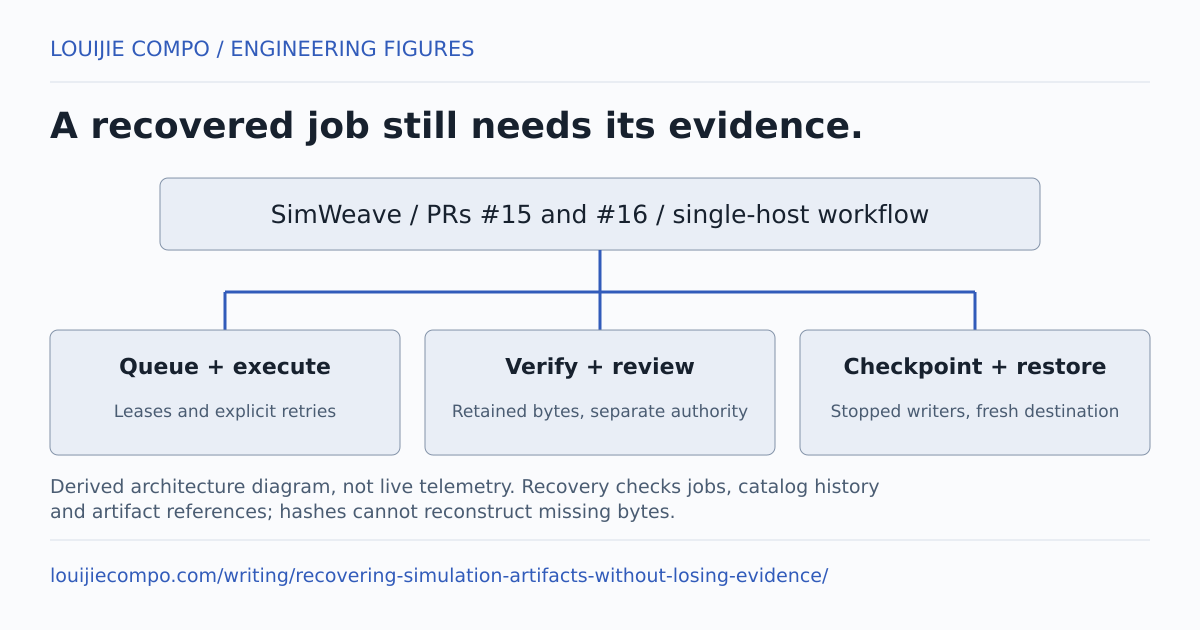
A job says it completed. A catalog says its build was reviewed. Neither is enough if the original recording has disappeared.
SimWeave's newer operational workflow connects those records to retained evidence. PR #15 (opens in a new tab) adds durable artifacts and worker-scheduled suites; PR #16 (opens in a new tab) connects completed jobs to catalog review, operational metrics and coordinated recovery. This article follows reviewed revision 48474cb and its retained upstream CI summaries.
The operational-evidence section lets you inspect those summaries. It does not operate a queue or storage service. The website checked the source scripts, successful workflows and receipt bytes, but did not rerun the operational fixtures or independently verify their 1,000 underlying bundles.
Keep execution status separate from scientific success
The durable-operations contract (opens in a new tab) distinguishes a completed job from a passing experiment. A job marked succeeded produced a verified evidence bundle. Its review exit code still distinguishes passing gates, failed gates and simulator errors.
That is the same separation explored in A Verified Simulation Is Not an Approved Baseline: a statistical result informs review, while baseline promotion requires explicit authority. Durable storage preserves the material needed to inspect the decision; it does not approve it.
A worker can disappear without gaining a second chance silently
The worker drill schedules 100 jobs across four processes and two tenants. It also kills a worker after that worker claims a separate job. Lease expiry marks the attempt as lost. The job is not automatically executed again. An explicit retry produces another attempt, and completion from the original claim is rejected.
All three retained worker receipts, Windows filesystem, Ubuntu filesystem and Ubuntu local S3, report those checks passing. They also report that queued cancellation prevented execution. The S3 backend was a pinned local RustFS server, not a paid cloud deployment.
The boundary is important during a slow upload. An attempt that loses its lease cannot commit success, but its upload may still leave retained orphan evidence. The implementation does not expose deletion or garbage collection. Capacity planning and operator cleanup remain necessary, and retained objects are not compliance object lock.
Retain the bytes before creating the review reference
Catalog HTTP uploads retain the original ZIP before committing a build. Completed jobs can enter the same tenant's catalog through a separate importer permission. Execution credentials do not gain baseline authority, and catalog credentials do not gain execution authority.
Artifact reads verify a complete bounded bundle into temporary storage before returning bytes. An absent legacy bundle is different from an unavailable or corrupted one. The connected-operations guide (opens in a new tab) documents those responses and concurrency bounds. Older catalog imports and CLI history records still need their original bundles retained separately before artifact downloads or checkpoints can work.
Filesystem storage and optional S3-compatible storage share the integrity contract. An existing object is checked by SHA-256 and size rather than trusted through its ETag alone. The queue and artifact index still use local SQLite. Moving object bytes to S3 does not enable multi-host scheduling.
Checkpoint the relationship, not just the databases
The operator must stop the API and workers, resolve running jobs and prevent new catalogs from appearing during the checkpoint. Write reservations guard existing metadata, but do not constitute a live traffic-draining protocol.
The checkpoint gathers suite jobs, artifact metadata, catalog history and every indexed bundle, including retained orphans. It validates the references before publishing a complete snapshot into a fresh directory. Missing original bytes block completion. Knowing their digest cannot reconstruct them.
Restore checks file hashes, database integrity, inventory, paths and references. It stages the copied data, verifies those bytes again and publishes only into a new destination. It resets source worker presence so an old heartbeat cannot appear to describe a worker on the recovered host. Credentials, endpoints and host configuration are excluded; identity mappings must be supplied separately. The older single-run queue also needs a separate backup.
These are trusted operator-local checkpoints. Their hashes detect corruption, but an attacker able to rewrite both files and the manifest can defeat that check. The signed catalog interchange from PR #14 is a separate mechanism; it does not make these SQLite checkpoints safe to accept from untrusted sources.
Read the recovery measurements with their workload attached
The connected-operations CI run (opens in a new tab) ran at the reviewed PR #16 main revision. Each OS fixture completed 100 authenticated job-to-comparison flows across two tenants, retained 1,000 distinct small reference bundles, then checkpointed and restored the state.
| Retained CI receipt | Recovered bundles | Recovered jobs | Missing references | Checkpoint + restore |
|---|---|---|---|---|
| Windows / filesystem | 1,000 | 100 | 0 | 4.125 s |
| Ubuntu / filesystem | 1,000 | 100 | 0 | 1.104 s |
Both receipts report zero cross-tenant reads. The acceptance script (opens in a new tab) starts its timer after fixture creation and stops it after checkpoint plus restore, before the subsequent API checks. It then checks all 100 restored build downloads and both tenants' comparison histories.
The experiments are five-step reference fixtures with small evidence bundles. These individual observations are not a Windows-versus-Linux benchmark, a production recovery-time objective or a throughput guarantee. They also differ from the upstream local validation report's (opens in a new tab) 5.234 s filesystem and 5.500 s local-S3-to-filesystem observations. Those numbers belong to separate executions, not interchangeable measurements of one run.
The worker/storage drill (opens in a new tab) has a different timer: it measures its entire workload, including worker execution, failure controls, bundle creation and recovery. Comparing that total directly with the checkpoint-and-restore interval would answer the wrong question.
Metrics help locate failure, with limits of their own
Tenant-scoped metrics expose queue states, oldest queued age and currently lost worker jobs. Operator-wide CLI output adds cumulative lease losses, artifact attempts and worker freshness. The Prometheus format uses fixed metric names without tenant, token, subject, job, object or worker identity labels.
A recent heartbeat is evidence of activity, not proof that a simulator is healthy. A retrieval counter counts attempts, not confirmed client receipt. Artifact counters are best-effort if their metadata database is unavailable. Those limits belong beside the metrics, just as the stopped-writer requirement belongs beside a recovery time.
The engineering result is a bounded chain of evidence: a job produces verified bytes, a review pins its references, and a recovery drill checks that the relationship survives. Keeping that chain inspectable is more useful than presenting an isolated completion badge.