Engineering journal
A Verified Simulation Is Not an Approved Baseline
Recordings, controlled reruns, statistical decisions and approval history answer different questions. A SimWeave experiment shows where each boundary belongs.
Source: https://louijiecompo.com/writing/a-verified-simulation-is-not-an-approved-baseline/
About 5 min read
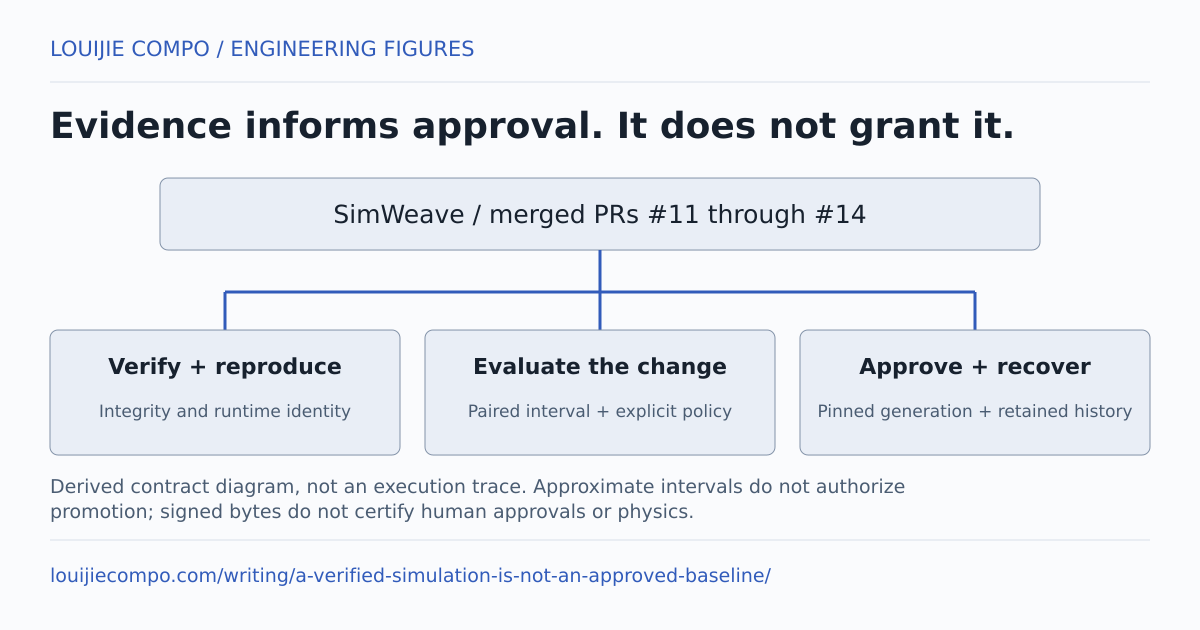
A controller comparison passes. Its recordings verify, and the upper endpoint of its estimated RMSE change sits below the allowed increase. Should it become the new baseline?
That result supplies evidence for a review. It cannot make the approval decision. SimWeave keeps the recording, statistical policy and baseline history separate so a reviewer can inspect what was measured, what was inferred and what was authorized.
This article follows the implementation merged through PR #14 (opens in a new tab), reviewed at revision 281b5b9. The decision workbench exposes retained CI reports, complete recordings and a separate synthetic recovery fixture. Nothing in the page executes a simulator or promotes a build.
First, establish what the recording says
A recording contains a scenario, result and full telemetry. Verification recomputes metrics, gates and digests. It can catch a result that no longer agrees with its samples. A checksum alone would be weaker: changed data can be accompanied by a newly computed checksum.
PR #11 (opens in a new tab) packages complete recordings into validated evidence bundles and generates standalone HTML reports. A reader can inspect a failure without starting the API or simulation engine. The bundle carries data; it does not supply executable code.
Internal consistency is still a narrow claim. It does not authenticate the producer or establish that a physical model represents a real robot.
Reproduce execution outside the original process
A controlled rerun asks a different question: does the retained environment reproduce the experiment? Source identity, installed implementation fingerprint, dependencies and the trusted container image must stay attached to the result.
The upstream reproduction validation (opens in a new tab) records six original runs and six fresh-container runs across reference, MuJoCo and Gazebo. Full results and telemetry digests matched, including deliberately failed quality gates. The suite still failed its gates while reproduction succeeded. Those are compatible outcomes.
This does not establish numerical equivalence across environments. It also does not meet a usability target by itself: direct file-open verification and the two-minute end-to-end download target remain unverified. This website reviewed the source evidence; it did not repeat those container executions.
Evaluate a practical difference, with uncertainty visible
PR #12 (opens in a new tab) adds paired regression decisions. The selected Gazebo study holds the scenario and seed fixed within each baseline/candidate pair. It uses 30 seeds, position-noise standard deviation 0.03 m and a positive candidate proportional gain of 8.1 instead of 8. These differ from the earlier ten-seed controller experiment.
For each seed, the analysis takes candidate RMSE minus baseline RMSE. It then resamples complete pairs with replacement 5,000 times to estimate a mean-change interval. The practical allowance is an increase of 0.02 m, chosen by the policy. It is an example tolerance, not a calibrated safety threshold.
| Retained Gazebo cohort | Mean RMSE change / m | Approximate 95% interval / m | Quality failures | Decision |
|---|---|---|---|---|
| Positive candidate | -0.00109104 | -0.00109328 to -0.00108881 | 0 | Within tolerance |
| Disabled controller | +0.75182517 | +0.75165953 to +0.75199526 | 30 | Regression |
The original reports and bundles contain the unrounded numbers. During this publication, the upstream reader verified all 120 recordings in these two cohorts and the analysis reproduced both decision reports exactly. That was saved-data verification, not a new physics run.
The decision contract (opens in a new tab) has three outcomes. A result is within tolerance when every selected upper endpoint is within its allowance and no relevant gate fails. A lower endpoint beyond tolerance or a known gate failure means regression. Overlap, too few pairs, constant changes, missing data or differing runtimes can make the evidence inconclusive. Missing seeds are not silently discarded.
These are approximate marginal intervals. They assume representative independent seeds and provide no multiple-testing or repeated-build correction. Trying many controller settings and reporting only the best one changes the interpretation; a separately retained evaluation population matters. Unique seed numbers alone do not prove independent or representative conditions.
Approval changes authority, not the measured result
A build import or statistical comparison leaves the approved baseline unchanged. Promotion requires an explicit action, reason, approval identity or label, policy and expected generation. A stale competing approval is rejected.
The separate retained catalog illustrates the mechanics with synthetic data. Generation 1 approves build-000; generation 2 approves build-001; generation 3 rolls back to generation 1's exact build and policy. Rollback adds an event rather than erasing the intervening decision. Its 100 builds use small two-seed populations that are inconclusive for statistical acceptance. They are a storage exercise, not approvals of the Gazebo candidate above.
PR #13 (opens in a new tab) adds portable catalog recovery and a tenant-scoped baseline API. This publication restored the downloaded Windows catalog and re-exported identical bytes. The catalog stores summaries and bundle digests; original telemetry needs separate retention. Single-host SQLite and local operator access remain explicit boundaries.
Signed recovery answers who produced these bytes
PR #14, merged on 15 October, adds optional OIDC access-token validation and signed catalog recovery. A server maps accepted identities to configured tenant roles. An operator can check a GitHub attestation against an explicit repository, workflow, ref and commit policy before restore.
The trusted-evidence validation (opens in a new tab) reports a real signed synthetic catalog restored on Linux and Windows, with five provenance or tampering controls rejected. This website did not independently rerun cryptographic verification. No commercial identity-provider enrollment, production deployment or instantaneous revocation is established; cached keys remain trusted until their configured expiry.
An authenticated producer and intact archive do not certify every historical approval label, and a signature does not validate physics. The useful chain is explicit: verify the record, inspect the statistical policy, make an authorized decision, then retain enough evidence to explain and recover it.