A controller comparison passed. What justified that decision?
SimWeave
From recorded experiment to recoverable evidence. Inspect statistical decisions, explicit approvals, operator-controlled recovery and optional distributed execution. A completed job still needs a scientific decision.
Experimental cart evidence and approximate statistical intervals. Optional PostgreSQL workers retain one local catalog authority; distributed restoration and physical multi-host validation remain unverified. No automatic baseline approval.
Latest verified change · PR #18 ↗ · Merged
Restore paused; distribute execution explicitly
PR #17 adds a suite workspace and paused local restore. PR #18 adds optional Keycloak tokens and PostgreSQL scheduling with shared S3 artifacts. The 1,000-job distributed drill used two containers on one physical machine; coordinated PostgreSQL restoration remains unverified.
Verified · PR #18 · 622c2c1b5092
Source checked . Documentation and retained evidence review, not a new runtime test.
Read change evidence ↗Professional relevance
Useful for experiment design, simulation-based diagnosis and machine-readable feedback. Recorded results remain bounded by their original test conditions.
Explore the engineering background →Operational evidence / PRs #17 and #18
Recovered does not mean authorized to run.
Follow the local maintenance boundary, then inspect the separate distributed-backend experiment. Open a step for its source and failure behavior. This is a documented workflow, not a live service.
Pause admissionFence new writes and claims.
Current-version cooperating processes share a maintenance fence. Reads remain available and active workers finish. Legacy and external writers must be stopped separately.
Read the sourceDrain and checkpointResolve attempts, preserve bytes and references.
Unresolved jobs or busy workers block drain. After a crash, stop all workers and wait for lease expiry before acknowledging them stopped. Failed drain or copy leaves admission paused; it does not retry jobs.
Read the sourceRestore pausedVerify a fresh local destination.
Restore verifies hashes and references, clears worker presence and starts paused. Identity and backend configuration are supplied separately. Source and restored queues must not run as the same logical service.
Read the sourceResume explicitlyReview before admitting work.
Successful checkpoint and restore both preserve the pause. An operator explicitly resumes admission. Failed jobs still require explicit retry. Process-interruption tests do not prove hardware power-loss resilience.
Read the source
Local volume recovery / PR #17
Upstream reports 10,739,384,838 physical bytes, 273 bundles and 273 synthetic terminal job references, with zero missing references. Checkpoint: 57.593 s. Restore: 118.359 s. These are full-copy observations from one local Windows drill, not 273 simulation executions. The volume fixture has no catalog records.
Inspect upstream evidenceOptional distributed queue / PR #18
Upstream reports 1,000 jobs, eight worker processes and four killed-worker attempts recovered after explicit retry. Both isolated worker containers ran on one physical machine. PostgreSQL coordinates claims and shared S3 retains artifacts; the catalog remains one API-host SQLite authority.
Inspect upstream evidenceProvider identity has a revocation boundary
The Keycloak fixture exercises two tenants and three roles. Provider logout or refresh-token revocation does not immediately invalidate an otherwise valid offline-checked access token. Human browser login was not tested.
Inspect upstream evidenceThe local checkpoint flow above does not apply to PostgreSQL: those recovery commands reject it. Coordinated cross-store PostgreSQL restoration, database HA and two physical hosts remain unverified. Source reports and passing integrated CI were reviewed; no workload was rerun for this website.
Why should a recovered system remain paused? →Operational evidence / PRs #15 and #16
Recover the evidence, not just the job status.
A completed job can feed retained, verified bytes into catalog review. The recovery drill checks that jobs, decisions and original artifacts still agree after restore. Inspect the saved CI receipts below; no workers or storage services run in this page.
- Stop writers first. Stop the API and workers, resolve running jobs and keep new catalogs out of the checkpoint window. Write reservations guard consistency; they do not drain live traffic.
- Retain bytes and references. Copy suite jobs, artifact metadata, catalog history and every indexed bundle, including retained orphans. A missing original blocks completion; a digest cannot reconstruct it.
- Restore into a fresh destination. Check hashes, database integrity, inventory and references, then verify staged bytes before publication. Reset worker presence and supply identity mappings separately.
Windows / filesystem: coordinated recovery
- Bundles recovered
- 1,000
- Jobs recovered
- 100
- Missing references
- 0
- Checkpoint + restore
- 4.125 s
The upstream drill completed 100 authenticated review flows across 2 tenants and reported 0 cross-tenant reads. It used small five-step reference experiments. The timer covers checkpoint plus restore, after fixture creation and before post-restore API checks. This single observation is not a recovery-time guarantee or a platform speed comparison.
Original Windows recovery receipt · JSONUbuntu / filesystem: coordinated recovery
- Bundles recovered
- 1,000
- Jobs recovered
- 100
- Missing references
- 0
- Checkpoint + restore
- 1.104 s
The upstream drill completed 100 authenticated review flows across 2 tenants and reported 0 cross-tenant reads. It used small five-step reference experiments. The timer covers checkpoint plus restore, after fixture creation and before post-restore API checks. This single observation is not a recovery-time guarantee or a platform speed comparison.
Original Ubuntu recovery receipt · JSONWorker loss: explicit retry, stale completion rejected
A separate drill schedules 100 jobs across four processes and two tenants. It kills a claimed worker, waits for lease expiry, verifies no automatic re-execution, explicitly retries, and rejects completion from the old attempt. Queued cancellation prevents execution.
- Windows / filesystem: worker counts 25 / 22 / 26 / 27; 1,000 bundles retained and recovered. Original Windows / filesystem worker receipt · JSON
- Ubuntu / filesystem: worker counts 27 / 24 / 26 / 23; 1,000 bundles retained and recovered. Original Ubuntu / filesystem worker receipt · JSON
- Ubuntu / local S3: worker counts 25 / 25 / 26 / 24; 1,000 bundles retained and recovered. Original Ubuntu / local S3 worker receipt · JSON
The S3 backend is a pinned local RustFS server. These receipts time the whole worker and storage workload, unlike the checkpoint-and-restore observations above. S3 storage does not make scheduling distributed across hosts.
What operational metrics can and cannot establish
Tenant-scoped metrics expose queue states, oldest queued age and lost worker jobs. Operator-wide CLI metrics add lease losses, artifact attempts and worker heartbeat freshness without identity labels. A fresh heartbeat does not prove simulator health, and a successful retrieval attempt does not prove the client received the download. Artifact counters are best-effort when their metadata database is unavailable.
Evidence boundary: these are original upstream CI summaries from the reviewed source revision. This website checked the source scripts, workflow success and retained receipt bytes; it did not rerun these operational fixtures or independently verify their 1,000 underlying bundles.
Single-host SQLite, small reference fixtures and stopped writers. No production recovery-time guarantee, multi-host scheduling, deletion or garbage collection. Local checkpoints are trusted operator backups, not signed interchange for untrusted databases.
Recovery CI ↗ (opens in a new tab) · Worker CI ↗ (opens in a new tab) · Receipt hashes
Read how the 1,000-artifact recovery drill works →Decision workbench / Recorded CI evidence
A pass supplies evidence. Approval needs a decision.
Inspect a passing candidate, a known failure and a separate recovery exercise. These controls reveal saved evidence; they do not run physics, recalculate statistics or change an approved baseline.
01 / Candidate: within tolerance
Gazebo / 30 paired seeds / 60 verified recordings. Candidate minus baseline RMSE, in metres:
- Mean change
- -0.00109104 m
- Approximate 95% interval
- -0.00109328 to -0.00108881 m
- Allowed increase
- 0.02 m
- Quality failures
- 0
The upper interval endpoint is below the allowed increase, and no quality gate fails. This is evidence under the chosen policy, not permission to promote the build.
Original statistical decision · JSON · Complete verified recordings · ZIP
02 / Disabled controller: regression
Gazebo / 30 paired seeds / 60 verified recordings. Candidate minus baseline RMSE, in metres:
- Mean change
- 0.75182517 m
- Approximate 95% interval
- 0.75165953 to 0.75199526 m
- Allowed increase
- 0.02 m
- Quality failures
- 30
The lower interval endpoint exceeds the allowed increase. All 30 candidate recordings also fail quality gates. Those failures remain decisive even if another metric improves.
Original statistical decision · JSON · Complete verified recordings · ZIP
03 / Approval history: promote, then roll back
A separate synthetic portability fixture retains 100 builds, 100 comparisons and three approval events. Its two-seed populations are inconclusive for statistical acceptance. These are test labels, not human approvals of the Gazebo candidate above.
- Generation 1: promote build-000. Requires expected generation 0 and an explicit approval record.
- Generation 2: promote build-001. Requires expected generation 1 and an explicit approval record.
- Generation 3: roll back build-000. Restores generation 1's exact build and policy; earlier events remain intact.
The downloaded Windows catalog restored and re-exported with identical bytes during this website review. Recovery preserves decisions; it does not rerun experiments or certify who made historical approvals.
When evidence is inconclusive: overlapping tolerance, too few pairs, constant changes, missing seeds or differing runtimes prevent a statistical pass. Known quality failures still take precedence.
The paired bootstrap uses 5,000 resamples. Its intervals are approximate, assume representative independent seeds and have no multiple-testing or repeated-build correction. The website verified 120 retained Gazebo recordings and recomputed both reports exactly; no new simulation was run.
Source CI run ↗ (opens in a new tab) · Verification and source revisions · Download hashes
Read: A Verified Simulation Is Not an Approved Baseline →Retained experiment / PR #10
A better response. A failure you can inspect.
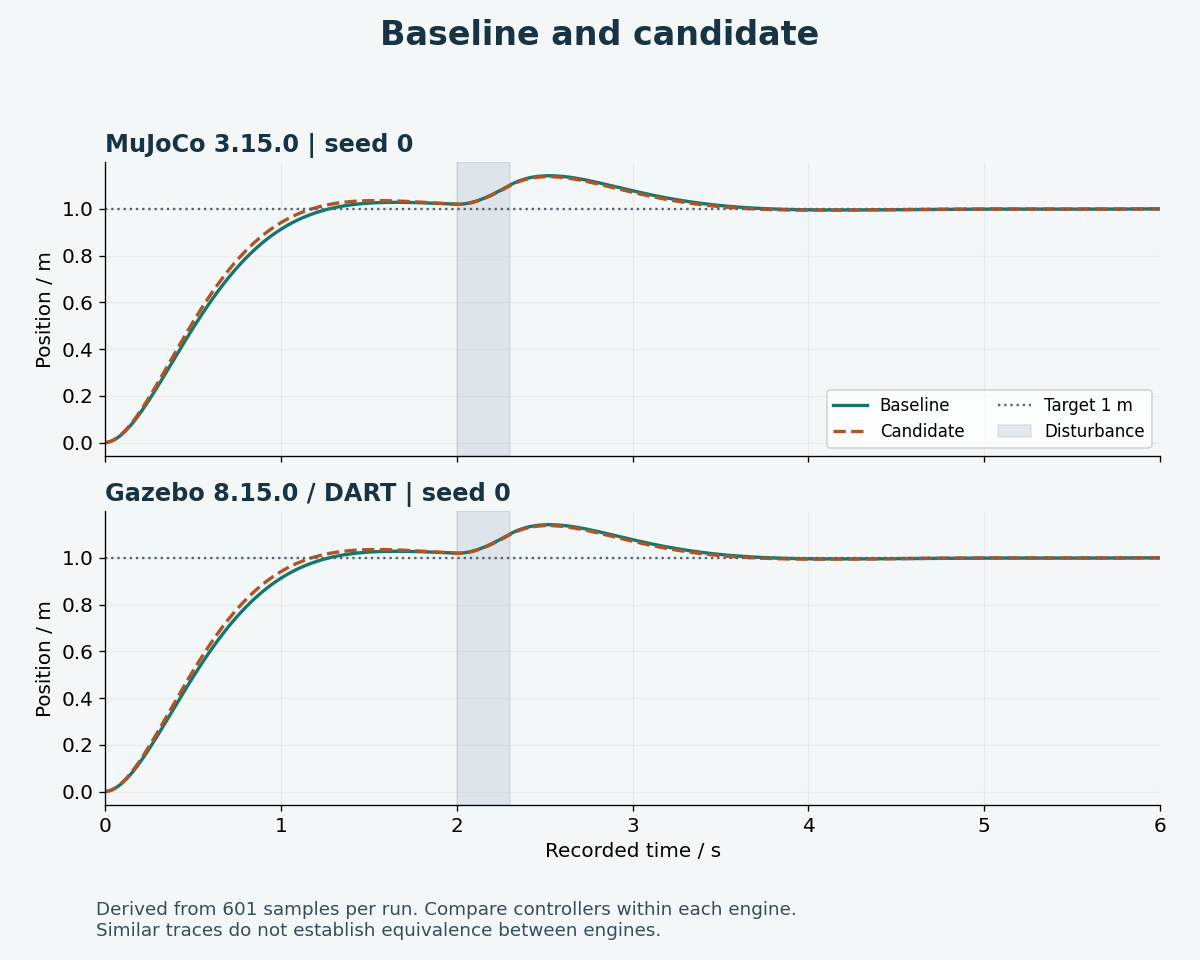
Twenty positive pairs pass. Twenty deliberately degraded pairs fail. Each cohort uses ten seeds in two engines, with a baseline and candidate in every pair. All 80 recordings passed integrity verification.
The positive candidate changes proportional gain from 8 to 8.5. The negative control sets both controller gains to zero. Target, noise, force pulse and acceptance rules stay fixed within each pair.
MuJoCo / Candidate / seed 0 / PASS
| Metric | Baseline | Candidate | Change |
|---|---|---|---|
| Final error / m | 0.000219 | 0.000266 | 0.000047 |
| RMSE / m | 0.252172 | 0.246662 | -0.005509 |
| Control effort / N s | 3.745634 | 3.893958 | 0.148325 |
Final-error gate: at most 0.05 m. RMSE regression gate: increase at most 0.02 m. Both recordings and the regression gate pass.
- Baseline: 601 samples. Scenario · Result and gates · Full telemetry
- Candidate: 601 samples. Scenario · Result and gates · Full telemetry
Gazebo / Candidate / seed 0 / PASS
| Metric | Baseline | Candidate | Change |
|---|---|---|---|
| Final error / m | 0.000219 | 0.000266 | 0.000047 |
| RMSE / m | 0.252172 | 0.246662 | -0.005509 |
| Control effort / N s | 3.745634 | 3.893958 | 0.148325 |
Final-error gate: at most 0.05 m. RMSE regression gate: increase at most 0.02 m. Both recordings and the regression gate pass.
- Baseline: 601 samples. Scenario · Result and gates · Full telemetry
- Candidate: 601 samples. Scenario · Result and gates · Full telemetry
MuJoCo / Disabled controller / seed 0 / FAIL
| Metric | Baseline | Candidate | Change |
|---|---|---|---|
| Final error / m | 0.000219 | 1.416609 | 1.416390 |
| RMSE / m | 0.252172 | 0.866644 | 0.614473 |
| Control effort / N s | 3.745634 | 0.000000 | -3.745634 |
Final-error gate: at most 0.05 m. RMSE regression gate: increase at most 0.02 m. The baseline passes. The disabled candidate fails both the final-error and RMSE regression gates.
- Baseline: 601 samples. Scenario · Result and gates · Full telemetry
- Candidate: 601 samples. Scenario · Result and gates · Full telemetry
Gazebo / Disabled controller / seed 0 / FAIL
| Metric | Baseline | Candidate | Change |
|---|---|---|---|
| Final error / m | 0.000219 | 1.416609 | 1.416390 |
| RMSE / m | 0.252172 | 0.866644 | 0.614473 |
| Control effort / N s | 3.745634 | 0.000000 | -3.745634 |
Final-error gate: at most 0.05 m. RMSE regression gate: increase at most 0.02 m. The baseline passes. The disabled candidate fails both the final-error and RMSE regression gates.
- Baseline: 601 samples. Scenario · Result and gates · Full telemetry
- Candidate: 601 samples. Scenario · Result and gates · Full telemetry
No simulator runs in this page. Verification recomputes saved metrics and digests; it does not authenticate the producer or validate the physical model.
Inspect the comparison record · Hashes and verification receipt
Related: AeroLoop studies controller behavior and contact interpretation →
Recorded data / 14 October 2026
Same experiment. Separate engine comparisons.
Compare the retained positive candidate with the deliberately disabled controller. Each figure keeps MuJoCo and Gazebo in separate panels.
Can the comparison catch a bad controller?
A comparison is useful when failure stays visible.
Derived from all 601 samples in each selected seed-0 recording. Plots do not establish cross-engine equivalence, real-world behavior or statistical significance. No simulation was run for this page.
In plain terms
Thirty paired Gazebo seeds put one candidate within the RMSE tolerance. A disabled controller fails. Neither result can approve a new baseline by itself.
Why it matters
Recordings, statistical policy and approval events answer different questions. Keeping them separate makes an engineering decision inspectable and recoverable.
Follow the example, step by step
Verify the evidence
Check complete recordings and runtime identity before interpreting a comparison.
Evaluate the change
Read paired intervals against a declared tolerance, retaining quality failures and uncertainty.
Approve explicitly
Pin the build, policy and approval generation. Preserve earlier decisions through rollback and recovery.
Keep statistical acceptance separate from baseline approval
Documented approach
A passing comparison supplies evidence. Promotion requires an explicit approval, pinned policy and expected generation; rollback appends a recoverable event.
Alternative and scope
Automatically promoting every passing candidate would confuse measured tolerance with authority and obscure repeated-tuning risk.
Cost of the choice
Approximate intervals require representative independent seeds. Signed archives establish producer provenance under policy, not physical fidelity or historical human consent.
What the evidence establishes
Both retained 30-pair Gazebo reports recompute exactly from 120 verified recordings. A separate synthetic 100-build catalog restores byte-identically; it does not approve those candidates.
Read the decision source (opens in a new tab)Execution, review and recovery keep separate authority
Editorial architecture map through PR #18. Optional PostgreSQL workers share S3 artifacts; catalog review retains one local authority. The local checkpoint flow restores paused. PostgreSQL coordinated restoration remains unverified.
Durable execution, bounded recovery
PR #15 introduces filesystem and optional S3-compatible artifact storage, tenant-scoped suite queues, cancellation and explicit retries. Expired attempts cannot commit success. That PR used local SQLite; PR #18 separately adds optional PostgreSQL scheduling. S3 storage alone does not create a distributed scheduler.
PR #16 connects retained job artifacts to catalog review and adds tenant-scoped metrics plus operator-wide metrics without identity labels. Coordinated checkpoints require stopped writers, validate the relationship between jobs, catalog records and bundle bytes, and restore into a fresh destination. No deletion or garbage collection is implemented.
A common contract, separate outcomes
SimWeave describes the world, robot, controller, sensor noise, disturbances, seed and quality gates in a common JSON scenario. The reviewed native evidence runs the built-in cart through MuJoCo 3.15.0 and ROS 2 Jazzy with Gazebo 8.15.0 / DART.
A baseline must pass its own quality gates. The candidate must also pass, and its RMSE increase must stay at or below 0.02 m. Similar-looking traces across engines do not establish interchangeable physics.
Bounded evidence, explicit limits
Each individual suite runs sequentially, with at most 64 runs and 200,000 steps. Durable suite jobs now support explicit retries, while the original experiment remains unchanged. The upstream dashboard displays at most 101 trajectory points per run; full-resolution telemetry determines the metrics. The plots here use all 601 samples in each retained seed-0 recording.
This website verified the downloaded CI recordings without rerunning physics. Eight selected recordings remain downloadable here. The eighty-record aggregate refers to the complete downloaded native cohort, not a fresh simulation or a statistical confidence estimate.
These earlier PR #10 plots remain a dated experiment. The newer decision study above uses 30 seeds, different noise and a different positive controller; its statistics must not be attached to the earlier curves.
Reproduce, decide, approve, recover
PR #11 adds verified evidence bundles, standalone reports and controlled reruns. Upstream validation reproduced six original recordings in a fresh container, including expected failed gates. Direct file-open and the two-minute end-to-end download target remain unverified.
PR #12 adds paired statistical decisions and immutable baseline history. Its upstream validation covers 360 reference, MuJoCo and Gazebo recordings plus 20 separately recorded controller candidates. Intervals assume representative independent seeds and do not correct for multiple testing or repeated tuning.
PR #13 adds portable recovery and a tenant-scoped baseline API. PR #14 adds optional OIDC access-token validation and GitHub attestation checks under an explicit producer policy. The catalog remains a single API-host SQLite authority. PR #18 adds a tested Keycloak service-account profile, while human login and production deployment remain unverified; offline access tokens remain valid until expiry. Historical approval labels do not become authenticated human decisions merely because an archive is signed.
Related writing
Inspect the checked source
Evidence reviewed . Individual decisions and captured examples retain their own source revisions and limitations.
Read the checked README (opens in a new tab)- Merged operator workspace and maintenance, PR #17 (opens in a new tab) ↗
- Merged optional provider and distributed queue, PR #18 (opens in a new tab) ↗
- Integrated provider/distributed CI (opens in a new tab) ↗
- Merged durable operations, PR #15 (opens in a new tab) ↗
- Merged connected recovery, PR #16 (opens in a new tab) ↗
- Merged regression work, PR #10 (opens in a new tab) ↗
- Native CI recordings (opens in a new tab) ↗
- Regression contract and limits (opens in a new tab) ↗
- Merged evidence bundles, PR #11 (opens in a new tab) ↗
- Merged statistical decisions, PR #12 (opens in a new tab) ↗
- Merged catalog recovery, PR #13 (opens in a new tab) ↗
- Merged identity and signed recovery, PR #14 (opens in a new tab) ↗