Engineering journal
Why Should a Recovered System Remain Paused?
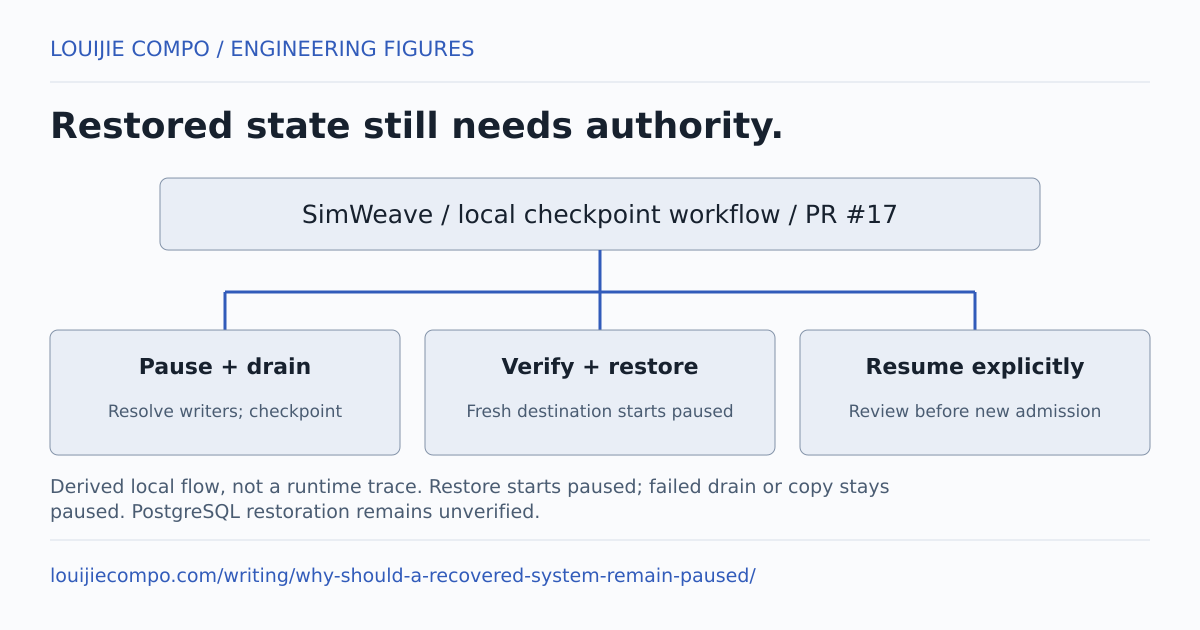
Restoring bytes and references does not authorize new work. SimWeave's local maintenance workflow makes pause, drain, verification and explicit resumption separate decisions.
Source: https://louijiecompo.com/writing/why-should-a-recovered-system-remain-paused/
About 4 min read
A restored queue may contain valid jobs and intact evidence while still being unsafe to resume. The original workers might remain alive. Credentials may refer to the old environment. A failed attempt may need review before anyone retries it.
SimWeave's merged PR #17 (opens in a new tab) makes that distinction visible: a successful checkpoint leaves admission paused, and a fresh restore also starts paused. An operator explicitly resumes work after inspection. The case study separates this local recovery workflow from the optional distributed backend introduced by PR #18.
This article follows public revision 622c2c1. It reviews implementation documentation and upstream validation; no recovery workload was rerun for the website.
Pause admission before draining work
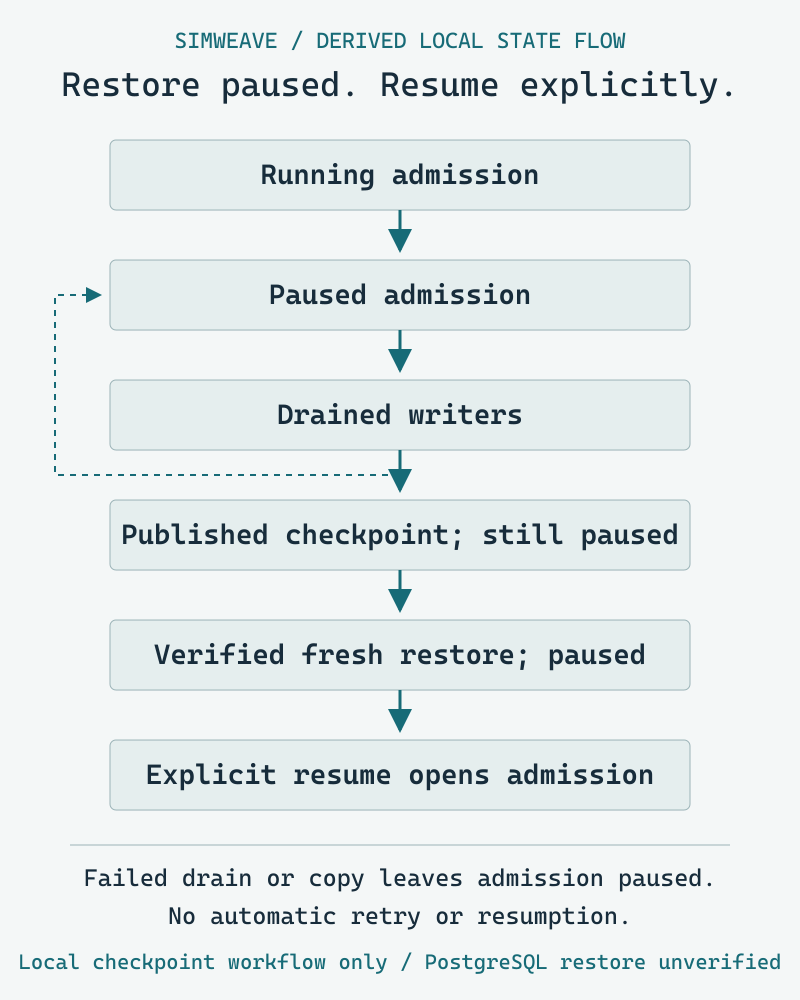
The maintenance guide (opens in a new tab) describes a fence shared by cooperating current-version processes on one local host. It prevents new suite submissions, retries, claims and covered writes. Reads remain available. Active workers finish their current attempt.
That is a useful intermediate state. Pausing prevents additional work from entering, while draining establishes that existing writers have finished. Legacy catalog CLI writers and external metadata or object writers must be stopped separately. The independent legacy experiment-run store is excluded from this checkpoint.
Checkpoint can perform pause and drain automatically. A drain timeout or failed checkpoint leaves admission paused. Success also preserves the pause. The workflow therefore gives the operator the same review point after both failure and success.
A stale heartbeat is not proof that a writer has stopped
A cancelled job can still have a worker unwinding its attempt. Drain refuses unresolved running jobs or busy workers rather than treating cancellation as immediate quiescence.
After a worker crash, the documented procedure requires stopping all source workers and waiting for outstanding leases to expire before explicitly acknowledging them stopped. That assertion removes stale worker presence and marks expired attempts failed. It neither retries the jobs nor resumes admission.
This distinction preserves two decisions: whether a writer can still publish, and whether a failed job should run again. The former is necessary for a consistent checkpoint; the latter remains an explicit operational choice.
Restore evidence into a fresh destination
Restore checks metadata and object hashes, inventory and references before publishing a fresh runtime directory. It clears worker presence and starts with admission paused. Identity mappings and backend configuration are supplied separately; restoring data does not restore permission to act.
The operator must also avoid running both source and restored queues as the same logical service. A correct copy cannot prevent an independently running old service from accepting new work.
These are full byte copies. Capacity planning must account for source, checkpoint and restored data. A digest can detect missing or altered bytes; it cannot recreate a missing original. The earlier 1,000-artifact recovery article explains that evidence-retention relationship using a different, dated fixture.
Read the local volume drill with its conditions attached
The PR #17 validation report (opens in a new tab) reports 10,739,384,838 physical bytes in 273 distinct bundles and 273 terminal job references. Checkpoint took 57.593 seconds; fresh-directory restore took 118.359 seconds, with zero missing references.
Those are local Windows development observations. The bundles derive from one semantically verified 200,000-step suite, with distinct ZIP dates and physical copies. Synthetic terminal job references exercise storage recovery at volume. This does not measure 273 simulation executions. The volume fixture has no catalog records; catalog consistency has separate regression coverage.
Injected copy failures and interruptions test process and workflow boundaries. They do not establish hardware power-loss resilience or a production recovery-time objective. The report records 290 passing tests for this slice. Later integrated-main operator CI (opens in a new tab) passed, but its smaller fixture is not the full-volume local timing run.
Keep the distributed-backend recovery question open
PR #18 (opens in a new tab) adds optional PostgreSQL scheduling, shared S3 artifact storage and a Keycloak access-token profile. Its validation report (opens in a new tab) records 1,000 jobs across eight workers in two isolated worker containers, plus four killed-worker attempts recovered after explicit retry. Both containers ran on one physical machine.
The local checkpoint workflow described above does not extend to PostgreSQL. Those commands deliberately reject that backend. The catalog remains one API-host SQLite authority, and coordinated cross-store backup, restore and cutover remain future work. Database restart persistence checks do not close that recovery gap.
The provider guide (opens in a new tab) also preserves an identity boundary: provider logout or refresh-token revocation does not immediately invalidate otherwise valid offline-checked access tokens. Human browser login was not tested.
Explicit resumption is a small interface decision with a larger systems consequence. It preserves space to inspect restored state, reconcile writers and configure authority before the system begins acting again.