Engineering journal
Why Did the Physics Engine Report Contact Five Metres Away?
AeroLoop reproduces a distant contact point and a downward normal in two diagnostic runs. The measurements agree, but their physical interpretation remains unresolved.
Source: https://louijiecompo.com/writing/why-did-the-physics-engine-report-contact-five-metres-away/
About 4 min read
Inspect the retained contact measurements
Twelve three-second Isaac GPU probes completed. Both default 1.25 ms repeats report a contact point 4.898484 m outside the vehicle collider, with a positive impulse along a downward normal.
A comparison setting, not a physics fix
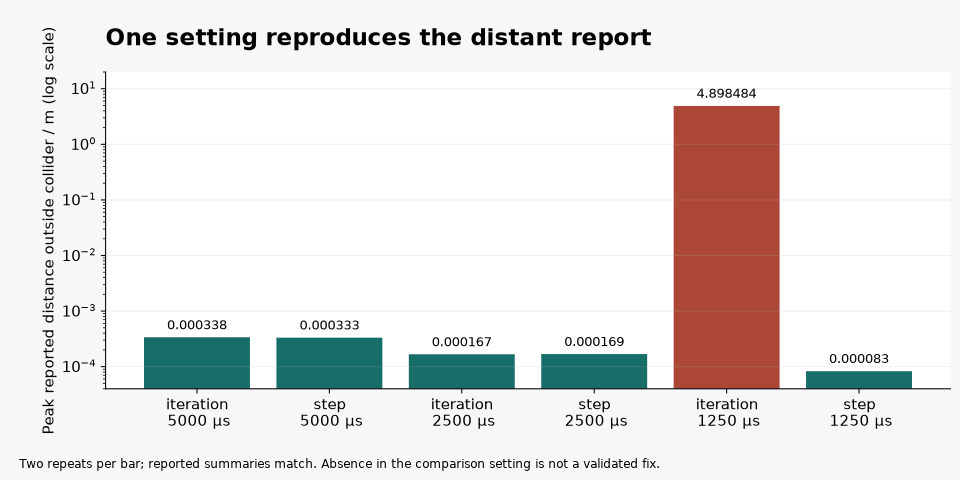
Default per-iteration, 1.25 ms: 1 negative interval in each repeat.
Peak reported distance outside the collider: 4.898484 m. Minimum aggregate normal Z: -0.06032943 N.
The distant report repeats. Its physical interpretation remains unresolved.
Inspect coordinates, impulse and all twelve results
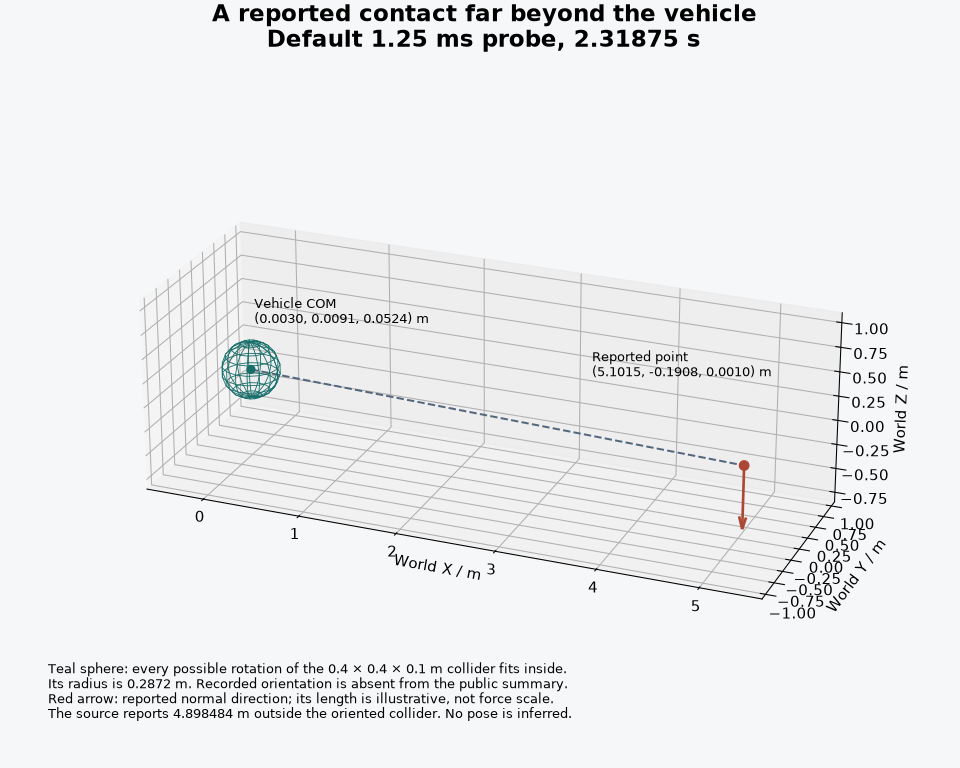
Vehicle COM: 0.002998, 0.009127, 0.052402 m. Reported contact: 5.101453, -0.190759, 0.001000 m.
Scalar impulse: +0.00007541179 N s. Normal approximately (-0.00041095, 0, -0.99999994). Aggregate normal Z: -0.06032943 N. Normal reconstruction error: 1.908 × 10^-12 N s.
| Case | Intervals | Negative intervals | Peak distance outside / m |
|---|---|---|---|
| per-iteration-dt5000-r1 | 600 | 0 | 0.000338 |
| per-iteration-dt5000-r2 | 600 | 0 | 0.000338 |
| per-step-dt5000-r1 | 600 | 0 | 0.000333 |
| per-step-dt5000-r2 | 600 | 0 | 0.000333 |
| per-iteration-dt2500-r1 | 1200 | 0 | 0.000167 |
| per-iteration-dt2500-r2 | 1200 | 0 | 0.000167 |
| per-step-dt2500-r1 | 1200 | 0 | 0.000169 |
| per-step-dt2500-r2 | 1200 | 0 | 0.000169 |
| per-iteration-dt1250-r1 | 2400 | 1 | 4.898484 |
| per-iteration-dt1250-r2 | 2400 | 1 | 4.898484 |
| per-step-dt1250-r1 | 2400 | 0 | 0.000083 |
| per-step-dt1250-r2 | 2400 | 0 | 0.000083 |
Evidence boundary. Diagnostic simulation only. Measurement consistency does not establish solver cause or physical validity. Original flight rejection and AL-010 remain open.
Only the public summary is retained here. This is not a new GPU run or playback of the upstream raw captures. The per-step setting is deprecated and remains diagnostic.
Numerical report · JSON · Source validation record · Figure provenance and hashes
Inspect the pinned source (opens in a new tab) ↗ · Read the contact investigation →
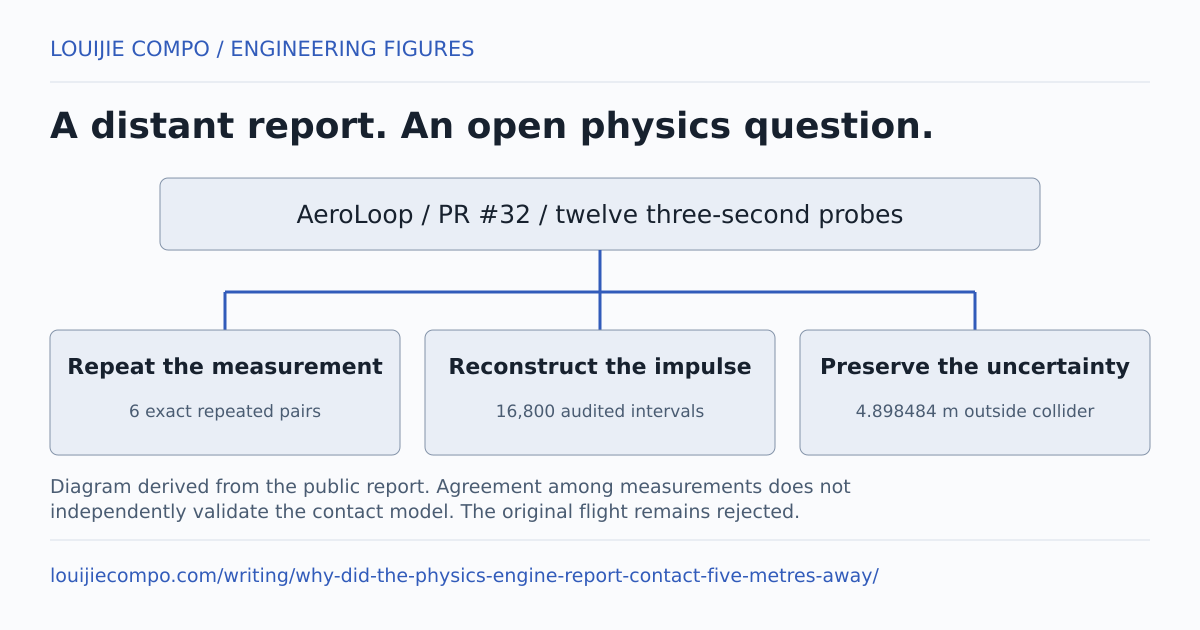
A simulation reported ground contact near world X = 5.10 metres while the vehicle's centre was near X = 0.003 metres. The source's oriented-collider calculation placed that contact 4.898484 metres outside the vehicle. The contact impulse was positive, yet its geometric normal pointed downward.
That is an observation to investigate, not an explanation of what the solver did internally. AeroLoop's PR #32 investigation (opens in a new tab) reproduced the report and checked its accounting while preserving the failed flight evidence that prompted the work.
Start with the rejected measurement
The earlier friction audit attempted a 50-second flight at a 1.25 ms physics step. Its reader rejected a negative ground-normal force at the 2.320 s control boundary. The recording did not become accepted merely because its other values looked plausible.
The follow-up uses a separate diagnostic schema (opens in a new tab) that retains signed measurements. This allows an investigation of the rejected value without weakening the original flight contract. Three-second probes stop before mission scoring, so a completed probe is not a passed flight.
Declare a small comparison matrix
The experiment holds the seed at 301 and control at 200 Hz, reusing the native controller, rotor model, wind, material, geometry and ideal feedback. It compares 5 ms, 2.5 ms and 1.25 ms physics steps, two TGS external-force integration settings and two repeats of each configuration.
All twelve declared probes completed. An earlier development capture was excluded and remains separate. Six repeated pairs matched across every captured field. The default per-iteration cases also matched all 600 retained control-rate position, velocity and quaternion samples at each timestep over the interval (0, 3].
The finest-step historical prefix was hash-intact, but its original flight remained unverified. Repeatability of a prefix does not overrule that rejection.
Separate the scalar impulse from its direction
At 2.31875 s, both default 1.25 ms repeats reported a scalar impulse of about +0.00007541179 N s along a normal approximately (-0.00041095, 0, -0.99999994). Its Z direction is downward. Multiplying impulse by that direction and dividing by the substep duration explains a negative Z force even though the scalar impulse itself is positive.
The aggregate and filtered normal Z values were approximately -0.06032943 N. The reported normal reconstruction error was 1.908 × 10^-12 N s, and the linear momentum residual magnitude was 3.354 × 10^-8 N s. This substep accounts for the negative five-millisecond interval average in the earlier recording.
Those checks align several representations of a measurement. They do not prove an attractive physical contact, a correct contact location or the internal cause of the report. The backend APIs share an engine; agreement between them is not independent validation of physical reality.
Show what the public geometry can establish
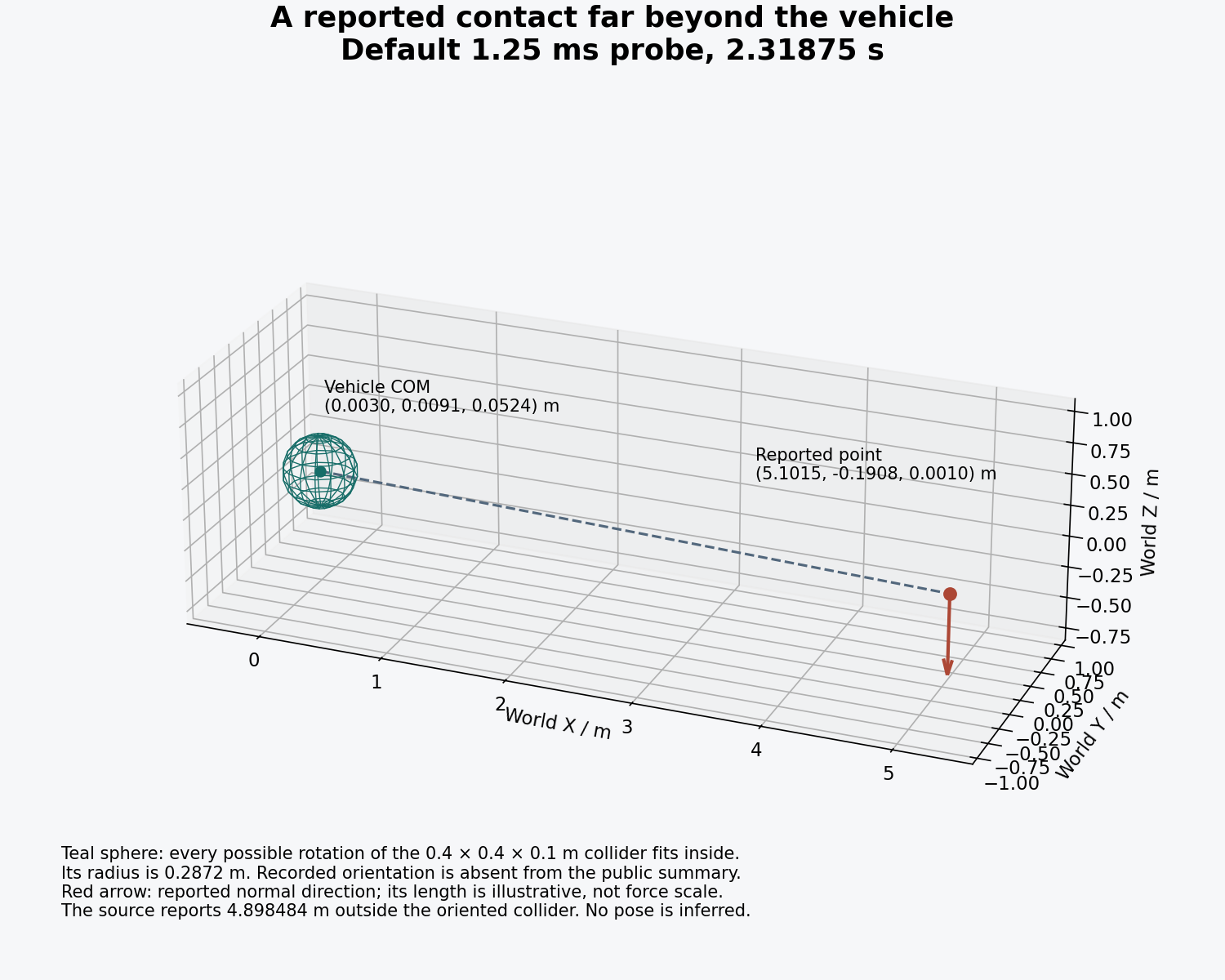
The figure plots the published vehicle-centre and contact-point coordinates in metres. The collider dimensions are 0.4 × 0.4 × 0.1 m. A sphere with radius equal to the collider's half-diagonal, about 0.2872 m, contains that box at every orientation.
The public summary does not include the incident quaternion. Drawing a particular rotated box would invent a pose. The sphere therefore shows an orientation-independent envelope, while 4.898484 m remains the source's reported distance outside the oriented collider. The arrow shows normal direction with a display length; its size is not an impulse measurement.
The upstream workspace can inspect actual raw collider/contact replay. Its raw captures and prepared demo bundles remain local upstream. This portfolio presents the public numerical record and derived figures, not that full replay or a new GPU execution.
Preserve the unanswered question
Independent arithmetic checked 16,800 substep intervals. Its maximum summary difference was about 6.111 × 10^-20, below the declared 2 × 10^-9 tolerance. No capture saturated the 64-item buffer; the observed peaks were five contact points and two friction anchors.
The per-step comparison setting did not reproduce the negative interval in this cohort. That setting is deprecated and remains diagnostic. Its result narrows the investigation; it does not justify changing the default or announcing a physics fix.
The documented next step (opens in a new tab) is a predeclared geometry-isolation study with angular as well as linear balance. The solver cause, physical interpretation, original full-flight rejection and AL-010 remain unresolved.