Engineering journal
Why a Drone Landing Physics Audit Still Couldn't Prove Convergence
Measured friction closes a momentum-accounting gap in AeroLoop, while failed mission gates and a rejected timestep keep the physics question open.
Source: https://louijiecompo.com/writing/why-a-drone-landing-physics-audit-could-not-prove-convergence/
About 5 min read
Nineteen fresh PhysX flights were attempted. Eighteen recordings verified: nine mission passes and nine failures. One timestep remains unverified.
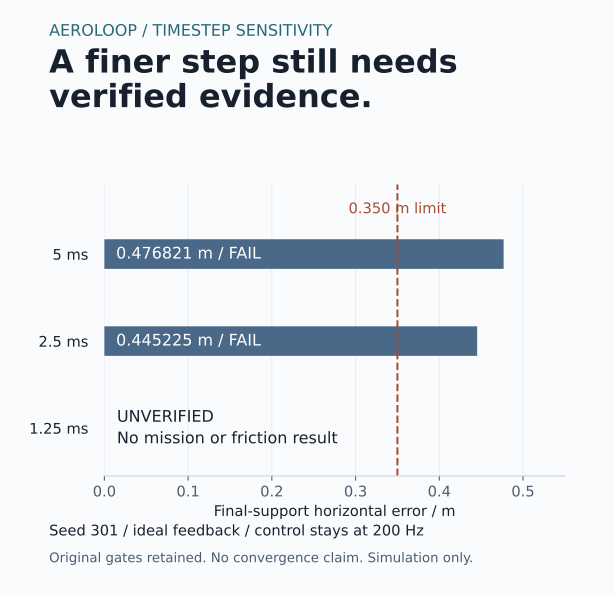
Rejected, not reclassified. The 1.25 ms capture reached 50 s, but its normal-force record contains -0.015082 N at 2.320 s. The original reader rejected it. It has no verified friction replay, work metrics or mission claim.
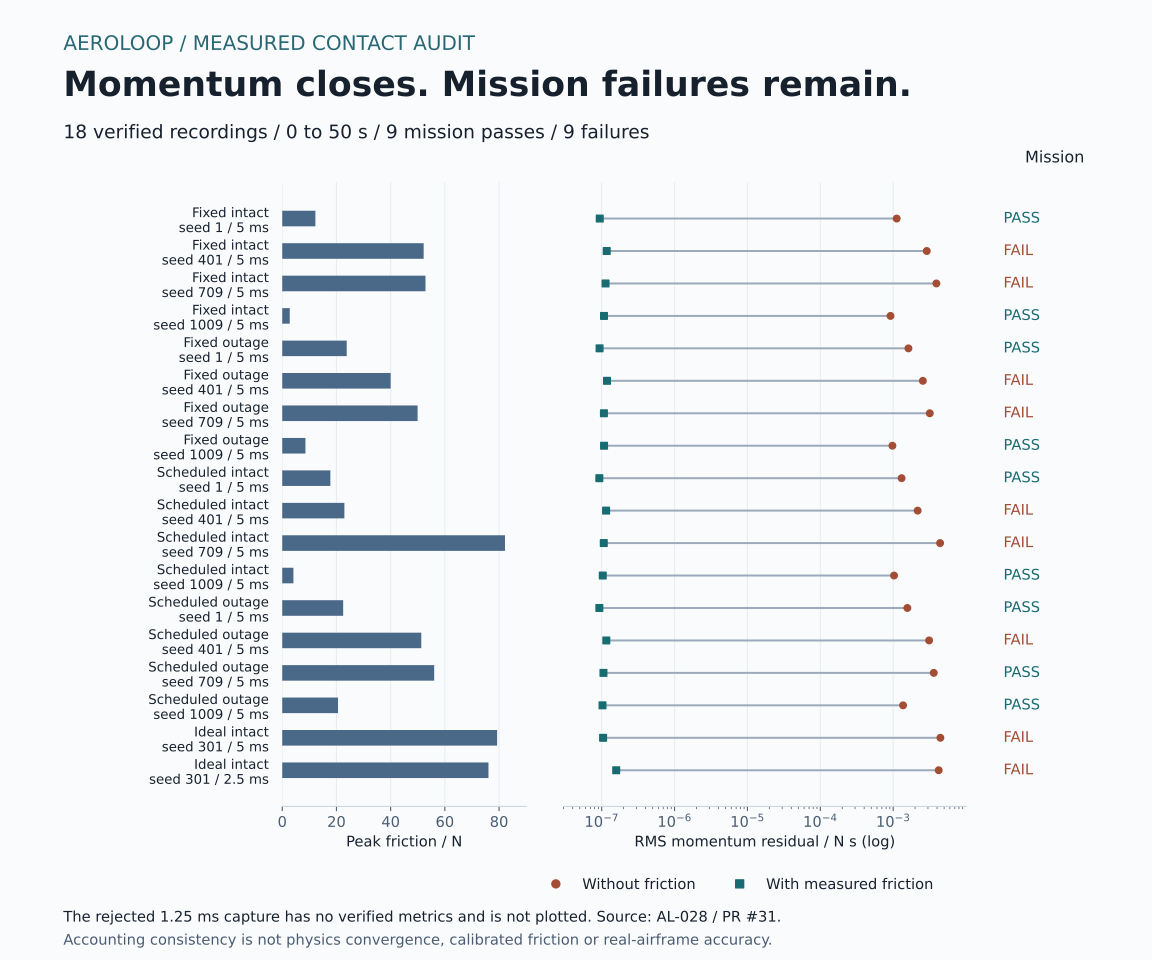
Read numerical values for all 18 verified recordings
| Case / mission | Peak friction / N | RMS residual / N s, without → with friction |
|---|---|---|
| fixed-intact-s1-dt5000 passed | 12.232 | 1.1170e-3 → 9.4008e-8 |
| fixed-intact-s401-dt5000 failed Gates: final_support_peak_xy_error_m | 52.181 | 2.8897e-3 → 1.1716e-7 |
| fixed-intact-s709-dt5000 failed Gates: horizontal, final_support_peak_xy_error_m | 52.855 | 3.9181e-3 → 1.1296e-7 |
| fixed-intact-s1009-dt5000 passed | 2.776 | 9.1930e-4 → 1.0756e-7 |
| fixed-outage-s1-dt5000 passed | 23.791 | 1.6200e-3 → 9.3498e-8 |
| fixed-outage-s401-dt5000 failed Gates: final_support_peak_xy_error_m | 40.001 | 2.5552e-3 → 1.1827e-7 |
| fixed-outage-s709-dt5000 failed Gates: horizontal | 49.945 | 3.1796e-3 → 1.0725e-7 |
| fixed-outage-s1009-dt5000 passed | 8.562 | 9.7617e-4 → 1.0779e-7 |
| scheduled-intact-s1-dt5000 passed | 17.749 | 1.3052e-3 → 9.2782e-8 |
| scheduled-intact-s401-dt5000 failed Gates: final_support_peak_xy_error_m | 22.933 | 2.1682e-3 → 1.1499e-7 |
| scheduled-intact-s709-dt5000 failed Gates: final_support_peak_xy_error_m | 82.192 | 4.4046e-3 → 1.0680e-7 |
| scheduled-intact-s1009-dt5000 passed | 4.122 | 1.0279e-3 → 1.0342e-7 |
| scheduled-outage-s1-dt5000 passed | 22.481 | 1.5660e-3 → 9.2858e-8 |
| scheduled-outage-s401-dt5000 failed Gates: final_support_peak_xy_error_m | 51.299 | 3.1117e-3 → 1.1571e-7 |
| scheduled-outage-s709-dt5000 passed | 56.065 | 3.6077e-3 → 1.0572e-7 |
| scheduled-outage-s1009-dt5000 passed | 20.585 | 1.3675e-3 → 1.0259e-7 |
| ideal-intact-s301-dt5000 failed Gates: final_support_peak_xy_error_m | 79.288 | 4.4472e-3 → 1.0462e-7 |
| ideal-intact-s301-dt2500 failed Gates: final_support_peak_xy_error_m | 76.100 | 4.2156e-3 → 1.5821e-7 |
Simulation-only. Small momentum residuals establish accounting consistency, not contact-physics convergence or real-airframe accuracy.
Inspect pinned validation ↗ (opens in a new tab) · Download retained numerical report
A smaller residual can make a simulation easier to explain without making its physics converged. AeroLoop's latest contact audit exposes that distinction: measured ground friction greatly improves momentum accounting, but the study still cannot establish contact-physics convergence.
The PR #31 validation record (opens in a new tab) preserves 19 attempted fresh PhysX flights. Eighteen recordings verify, with nine mission passes and nine failures. The remaining recording is unverified. Treating that last case as a pass, a failure with trustworthy metrics, or a zero-valued result would change what the evidence says.
Add the missing measurement
The earlier response experiment could compare wind and thrust with horizontal motion, but its unexplained work residual was not measured friction. This audit adds filtered ground-friction forces and contact-anchor diagnostics. The upstream contact lab aligns recorded motion, forces and acceptance results for inspection.
The filtered path uses a stationary kinematic ground body with the same geometry, pose and material. The default unfiltered static ground stays unchanged. Twelve previously recorded trajectories match the new captures exactly across all 10,001 states. That is a useful noninterference check for those twelve cases, not a guarantee about every configuration.
Independent arithmetic checks cover 180,000 control intervals from the verified recordings, with maximum error below 1.12 × 10^-16 against the reported calculations. These checks establish agreement between implementations of the accounting. They do not establish agreement with a physical drone.
Keep the cohorts and original outcomes visible
Sixteen flights use fixed or scheduled gains, intact feedback or a two-second outage, and seeds 1, 401, 709 and 1009. Two more verified flights use ideal feedback and seed 301 for the timestep investigation.
| Verified cohort | Recordings | Mission passes | Mission failures |
|---|---|---|---|
| Fixed gains, 5 ms physics | 8 | 4 | 4 |
| Scheduled gains, 5 ms physics | 8 | 5 | 3 |
| Ideal-feedback sensitivity, 5 and 2.5 ms | 2 | 0 | 2 |
This is a different cohort from the earlier 36-flight response study. Its nine passes out of eighteen verified flights should not be read as a regression from that study's scheduled-gain count of fifteen out of eighteen.
The force figure shows the effect of including measured friction in horizontal momentum accounting. Across the verified flights, full-flight RMS residuals fall from roughly 0.000919 to 0.004447 N s without friction to roughly 9.28 × 10^-8 to 1.58 × 10^-7 N s with friction. Mission outcomes remain separate and unchanged.
A row at time t describes the preceding five-millisecond control interval. Forces are averaged over its physics steps; the initial row has no preceding interval. Keeping those conventions explicit avoids comparing forces with the wrong change in momentum.
Preserve the timestep that fails verification
For seed 301 with ideal feedback, control stays at 200 Hz while the physics step changes. Final-support horizontal errors are 0.476821 m at 5 ms and 0.445225 m at 2.5 ms. Both exceed the original 0.350 m bound.
The 1.25 ms capture reaches 50 seconds, but the original normal-force reader and the friction sidecar reject it. At 2.320 seconds the record contains a negative normal-force sample of approximately -0.015082 N. The report retains that rejection instead of clipping the value or supplying replacement mission and work metrics.
The negative sample alone does not prove attractive physical contact. It identifies a discrepancy that needs isolation. With only two verified timestep results and an invalid third capture, the study cannot demonstrate numerical convergence.
Separate diagnostic visibility from physical truth
The contact-physics lab (opens in a new tab) computes horizontal translational work at the center of mass. That omits rotational and contact-point work. Center-of-mass velocity alignment is also not the same as contact-point slip.
Material values of 0.5 dynamic and 0.7 static friction are model references, not calibrated coefficients or mission gates. A remaining energy residual is not an additional friction measurement. The model still uses ideal attitude, simplified aerodynamics and contact supervision; yaw refinement remains open under AL-010. None of this establishes hardware flight accuracy.
The next useful experiment isolates the signed normal-force anomaly before changing validation or claiming convergence. It needs a verifiable finer-step capture under the original gates, with force sign, filtering and interval aggregation checked at the anomalous contact. A valid comparison can then ask whether the quantities of interest stabilize as the timestep shrinks.
The engineering value of this audit is a narrower, inspectable question. More measurements make a failure easier to investigate. Preserving the failed and missing evidence keeps that investigation honest.
Inspect the retained sources
The figures above are derived from the public numerical report and validation text. The full flight bundles remain local upstream, so the portfolio does not present a new trajectory replay. Its existing AeroLoop replay retains the identity of its earlier experiment.
The integrated revision's CPU check passed (opens in a new tab). That is upstream validation evidence. This publication reviewed the pinned sources and rendered their summaries; it did not run PhysX, train a policy or repeat the upstream runtime tests.