Engineering journal
What a QEMU Driver Lab Can Establish
Reading the independent PCI and ARM64 lab contracts without turning virtual-device evidence into physical-hardware claims.
Source: https://louijiecompo.com/writing/what-qemu-driver-evidence-can-establish/
About 2 min read
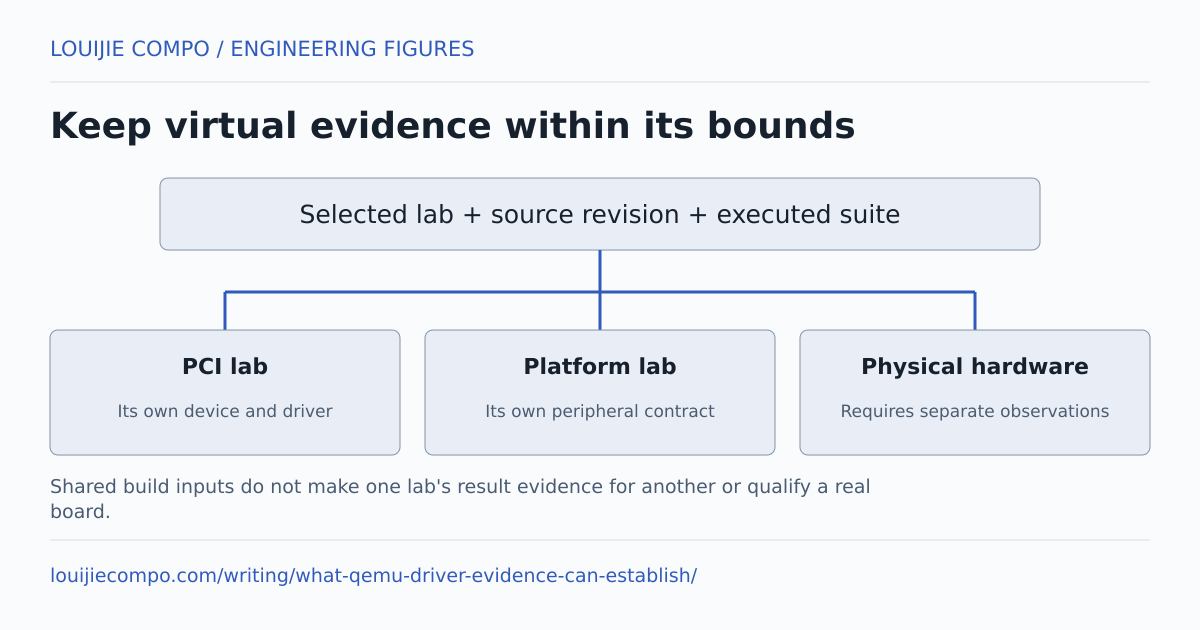
Name the hardware contract
A driver lesson becomes easier to interpret when the device contract is explicit. The reviewed Yocto and QEMU lab README (opens in a new tab) describes two lab manifests that share locked sources and an image target while keeping their hardware contracts independent.
The x86-64 path uses PCI discovery, BAR MMIO, MSI or INTx, and bounded DMA. The ARM64 path uses a project-local SysBus model, generated Device Tree, platform discovery, MMIO and one level interrupt. It does not expose DMA or reinterpret the PCI interface as a portable hardware contract.
Shared tooling does not erase differences
Those separate paths give a reader something more useful than a broad “multi-platform” label. They identify which discovery and interaction mechanisms each lab is intended to exercise. A feature documented for one path should not be attributed to the other merely because both use the same build system.
The educational value is in the distinction. A proposed comparison should first name the selected manifest and machine, then connect each assertion to that path's driver, diagnostic command and evidence schema. This is a way to frame a future report, not a claim that a new comparison was run for this article.
Preserve the limit of virtual evidence
A virtual-device result can document behavior in that selected environment. It does not establish behavior on an unspecified physical board. A hardware claim would need its own identified device, setup and observations; this portfolio has not supplied them.
The source also labels the project as a development version rather than a release. That qualifier belongs alongside the technical details, because it tells readers how to interpret the example.
The useful account is therefore precise: two independent virtual hardware learning paths, with shared build inputs and explicit limits. Physical-device qualification, broad portability and fresh runtime results remain separate claims that need separate evidence.