Engineering journal
The Drone Missed the Landing Before It Touched the Ground
AeroLoop's retained contact analysis finds two failed approaches already outside the final-support position bound at first contact. Small post-disarm changes point the next experiment upstream.
Source: https://louijiecompo.com/writing/the-drone-missed-the-landing-before-it-touched-the-ground/
About 4 min read
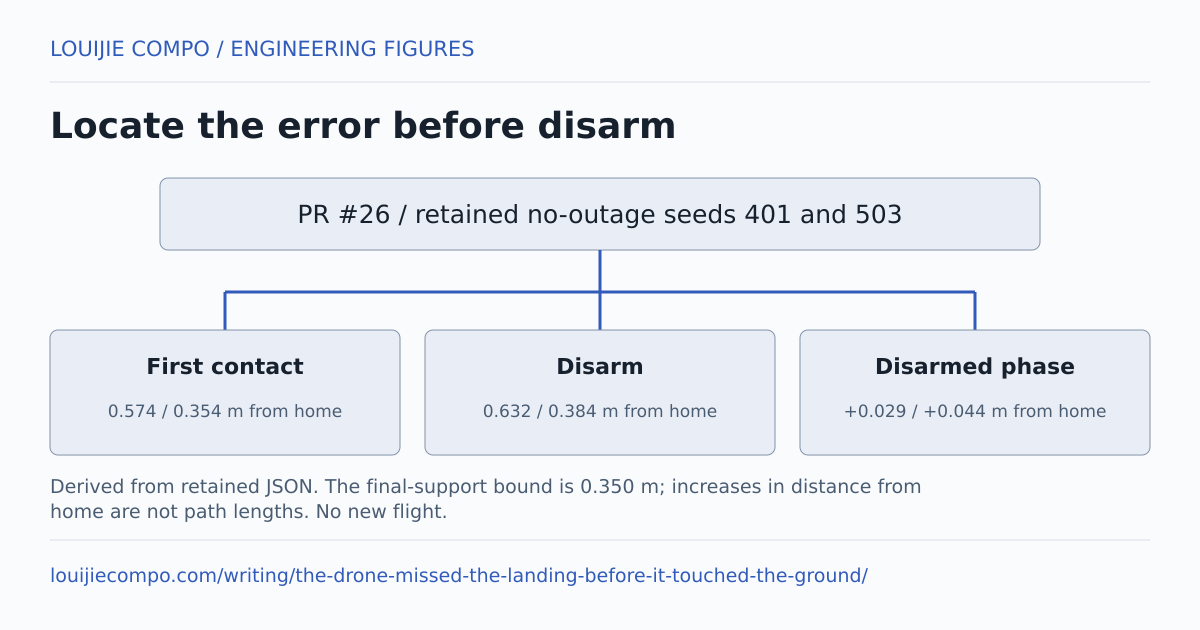
A drone can finish outside its landing boundary without most of the error appearing after touchdown. In AeroLoop's retained simulation, two no-outage cases are already too far from home at first contact. Their later motion matters, but it cannot explain away the approach error.
This is a diagnosis of a specific experiment, not a claim about every drone landing. AeroLoop is a simulation-only control lab. PR #26 analyzes 24 retained PhysX flights and 76,824 landing rows, adds zero flights, and leaves the original controller, physics, defaults and acceptance gates unchanged.
Compare contact with disarm
The landing-contact report preserves three useful points: first contact, motor disarm and the final support result. The two no-outage baseline cases below use additional seeds 401 and 503. The final-support position bound is 0.350 m.
| Seed | First-contact distance | Distance at disarm | Increase after disarm |
|---|---|---|---|
| 401 | 0.574 m | 0.632 m | 0.029 m |
| 503 | 0.354 m | 0.384 m | 0.044 m |
These are rounded values from the pinned landing-contact record (opens in a new tab). The last column is the increase in distance from home during the disarmed phase, not integrated path length. First-contact distance is compared with the final-support bound to locate an existing error; it is not a new touchdown acceptance gate.
Seed 401 arrives about 0.224 m beyond that bound. Seed 503 is only about 0.004 m beyond it, but still exceeds it before disarm. Both finish farther out. Contact orientation, lateral velocity and the approach therefore deserve inspection alongside the landing latch.
A better decay result still leaves a failed landing
The preceding PR #25 addresses a different part of the same investigation: a stale estimate of vertical disturbance during a two-second sensor-capture outage. An opt-in decay candidate gradually reduces that estimate. The original predictor remains the default.
The study uses 18 new final flights plus six retained references. Two development flights are excluded. Under the original gates, candidate mission passes improve from 7/12 to 8/12, same-mode outage pairs from 3/6 to 5/6, and sustained recovery windows from 8/12 to 9/12. The retained decay study (opens in a new tab) still records accepted: false.
The six no-outage candidates reproduce their baseline traces exactly. Outage candidates match before the outage begins. Those controls help isolate the change, while additional-seed support-position failures keep the candidate experimental. A better aggregate count does not establish general sensor-outage tolerance.
Inspect the approach before changing the latch
The contact lab places truth and feedback, horizontal control terms, rotor forces, tilt, contact episodes and phase summaries on the same retained timeline. It can step paired 3D playback at 5 ms and jump to contact or disarm. The full playback bundle remains local to AeroLoop; this portfolio publishes compact records and derived figures, not a new flight capture.
The engineering inference is narrow: a downstream landing change cannot, by itself, be assumed to repair an error that already exists on approach. That does not prove a particular controller term caused the error or that a later intervention could never recover it. The accepted design decision (opens in a new tab) prioritizes pre-contact tracking and contact orientation for the next bounded experiment.
Preserve what the analysis cannot establish
Offline readiness predicates describe the observed trace only through actual disarm. Changing a slider does not execute an alternate trajectory. A residual momentum term is not measured friction. Synthetic feedback, simplified simulation assumptions and small fixed cohorts do not establish hardware-flight safety. The independent AL-010 yaw-refinement issue remains open.
This is why the failed result belongs beside the improved counts. The next decision becomes more precise without turning diagnosis into a successful validation claim. Start with the latest engineering note, compare the earlier outage envelope, or inspect the landing lab's validation (opens in a new tab).