Engineering journal
An Observation Needs a World Revision
What Cogniform's revision-linked observations clarify about agent feedback, local transport and evidence.
Source: https://louijiecompo.com/writing/observations-need-world-revisions/
About 2 min read
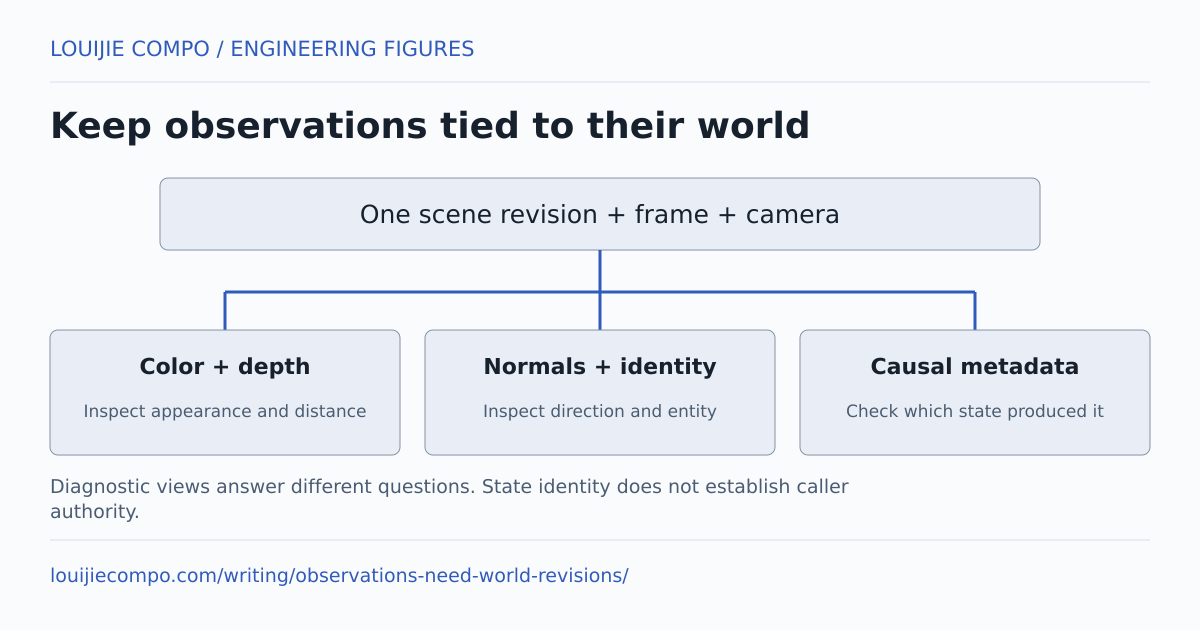
Feedback needs context
An image or depth buffer can tell a consumer something about a scene. It cannot, by itself, explain which scene state produced it. When a consumer can also change the world, that missing association matters: a result from an earlier state may be mistaken for feedback on a later edit.
Cogniform's pinned README (opens in a new tab) describes atomic world revisions and observations linked to the producing scene revision. Its implemented observations include color, depth, entity identifiers, visibility and normals. This is a documented engine contract, not a new measurement of an agent's performance.
Separate identity from authority
The same source describes a bounded observation envelope with causal metadata. It detects corruption but does not supply authentication or encryption. That distinction prevents a tempting shortcut: evidence that bytes are intact is not evidence that their sender is trusted.
The local CLI adapters also have a specific boundary. They use inherited streams and bounded requests; they do not introduce a network listener or a remote security boundary. Treating this local interface as a ready-made remote service would require claims beyond the reviewed documentation.
Make the next question inspectable
A useful future example could start with a known revision, apply a bounded change, and retain the resulting observation with its revision reference. A reader could then ask whether the observation actually belongs to the state under discussion. That would be an experiment to document, not something established by this article.
The broader design lesson is to keep several questions separate: what state produced the evidence, whether the payload is intact, and what authority the caller has. Each deserves its own contract and verification. Revision-linked feedback addresses the first question; it should not silently stand in for the others.
Cogniform remains an early core. This source-based reading makes no claim about remote-service security, general-purpose engine completeness, or observed improvements in agent reliability.
Inspect the actual diagnostic views discussed here. Each view belongs to the same scene revision and frame.
Captured output / 10 September 2026
One cube. Four ways to understand it.
A picture tells only part of the story. Select a view to inspect appearance, distance, surface direction or object identity from the same scene.
How does a tool connect a pixel to an object?
All four observations belong to frame 1 and scene revision 0. A tool can connect a pixel to the world it is allowed to change.
Original 64 × 64 diagnostic pixels captured on 10 September 2026, enlarged without smoothing. A single local example, not a performance or cross-device benchmark.