Engineering journal
What Embedded Engineering Teaches You About Reliable AI Agents
How explicit interfaces, resource bounds and recovery make agent-operated software easier to reason about, illustrated by independent public projects.
Source: https://louijiecompo.com/writing/what-embedded-engineering-teaches-you-about-reliable-ai-agents/
About 3 min read
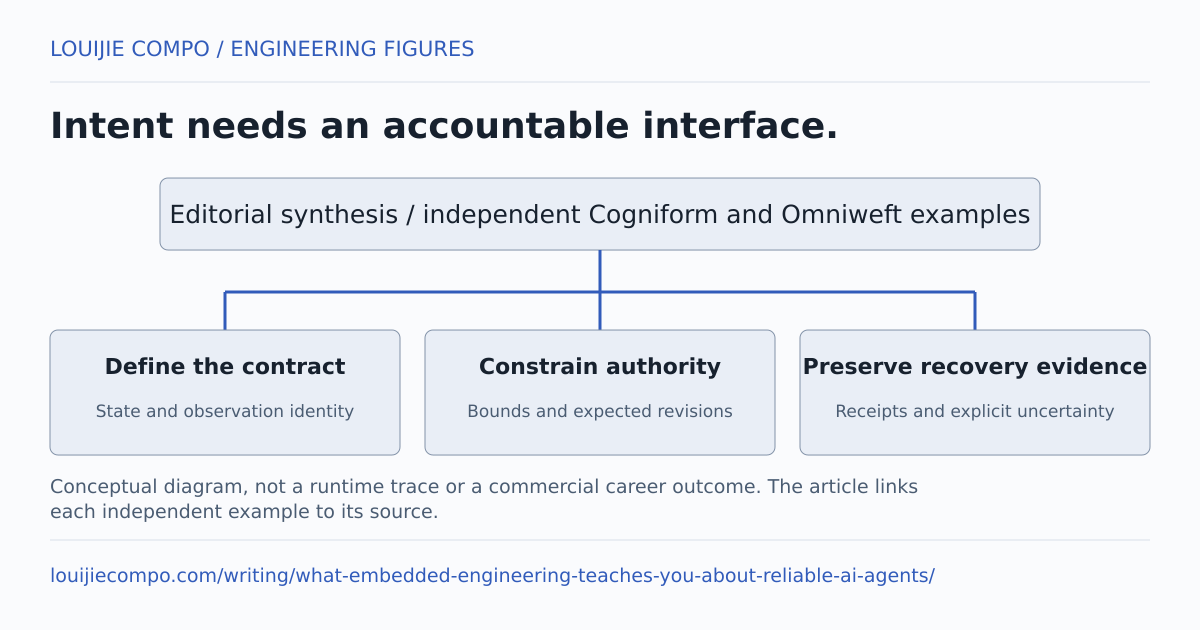
My professional background spans embedded and product engineering, architecture, technical leadership and applied AI. The public systems on this site illustrate ways of thinking about those disciplines. They are independent projects, not a record of commercial engagements or employer outcomes.
An AI agent makes requests through software. Those requests still need the engineering properties we expect from other interfaces: a defined vocabulary, bounded resource use, explicit authority and a way to explain what happened when something fails.
Give each interface a contract
An observation should describe the state it belongs to. A command should declare the change it requests. A receipt should make the resulting state inspectable. These are distinct responsibilities even when one tool exposes all three.
Cogniform's public observation contract (opens in a new tab) provides a concrete example. Its diagnostic image helps a caller inspect a view, while canonical observation data preserves exact values and the identity of the world revision. The convenient representation does not replace the authoritative record.
Make resource limits part of the design
An interface with no stated bounds leaves its caller guessing about acceptable workload and failure. Bounded messages, explicit quotas and clear ownership make failure easier to reason about. A system can decline a request without treating that decline as an unexpected accident.
The same discipline applies to inspection tools. A compact report can be useful without pretending that it includes every underlying detail. The limit should be visible so a reader knows when further investigation is needed.
Separate intent from authority
A useful proposed action is not automatically an authorized change. A caller's suggestion still needs validation against the current state and the permissions granted by the system's owner.
Omniweft's public work illustrates this boundary through bounded transactions, retained retries and explicit revisions. Its read-only asset-retention inspector (opens in a new tab) can explain why bytes remain stored and predict collection without granting new mutation authority. Inspection and action answer different questions.
Design recovery before calling the workflow reliable
A timeout can leave the caller uncertain about whether an action committed. Repeating it blindly may duplicate the effect. The retained worker-recovery example shows why recovery needs an identity and receipt model that preserves what is known, what is unknown and what can safely be tried again.
That framing is useful for agent tools because a convincing explanation from a model cannot settle the state of an external system. The implementation needs evidence that can be queried and checked.
Communicate the remaining boundary
For an engineering team, a useful result includes the assumptions, the executed checks and the conditions those checks do not cover. Public project evidence is one way to make that practice visible. It should complement an approved career history, not stand in for one.
Read the engineering background, then explore the Cogniform and Omniweft case studies for the implementation, evidence and limits behind these examples.