Engineering journal
What Does Deterministic Mean When Rendering and Audio Are Optional?
Separate the reproducibility of a canonical world from the behavior of the devices that present it.
Source: https://louijiecompo.com/writing/determinism-with-optional-rendering-and-audio/
About 2 min read
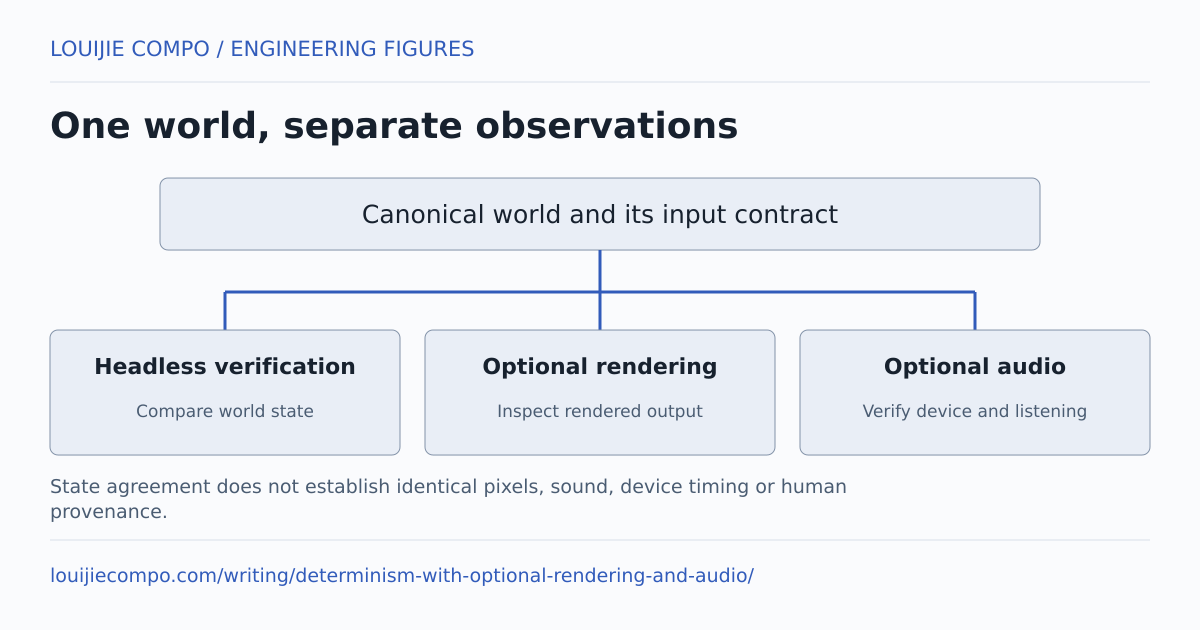
Specify what must agree
“Deterministic” needs a subject. Are two runs expected to agree on world state, rendered pixels, speaker output, elapsed wall time, or all four? Those are different contracts. A test becomes more useful when it names the comparison instead of relying on the adjective alone.
Presentation can have its own timing
LudoWeave's optional-audio contract (opens in a new tab) describes an explicitly pumped blocking output path. The constructing thread owns it; no Python callback performs the audio work. Blocking driver calls do not have a portable hard timeout, and buffered sound can lag a control change.
These are presentation concerns. A world-state comparison does not establish that a device opened, that a listener heard the intended sound, or that playback met a latency target. The contract treats provider tests, device execution and listening as separate evidence.
Use the test that answers the question
For replay, the input-history guide (opens in a new tab) describes a fresh process using the recording's owned inputs and checking state hashes and checkpoints. It does not require the original rendering or audio device. That is a specific reproducibility boundary, not a promise of identical physical output.
The practical rule is to record which boundary was exercised. A headless result can establish its recorded comparisons while leaving presentation untested. A listening report can add device evidence while leaving replay untested. Neither needs to overclaim what the other proves.
Read A Replay Is More Than a List of Inputs for the recording boundary, or explore the LudoWeave system map. These are source-based explanations; no new device test was performed for this article.