Engineering journal
Where AI Fits in the Larger System
What recent work on agent standards, on-device inference, and reliability has reinforced for me about building AI into real products.
Source: https://louijiecompo.com/writing/the-next-chapter-of-ai-is-systems-engineering/
About 3 min read
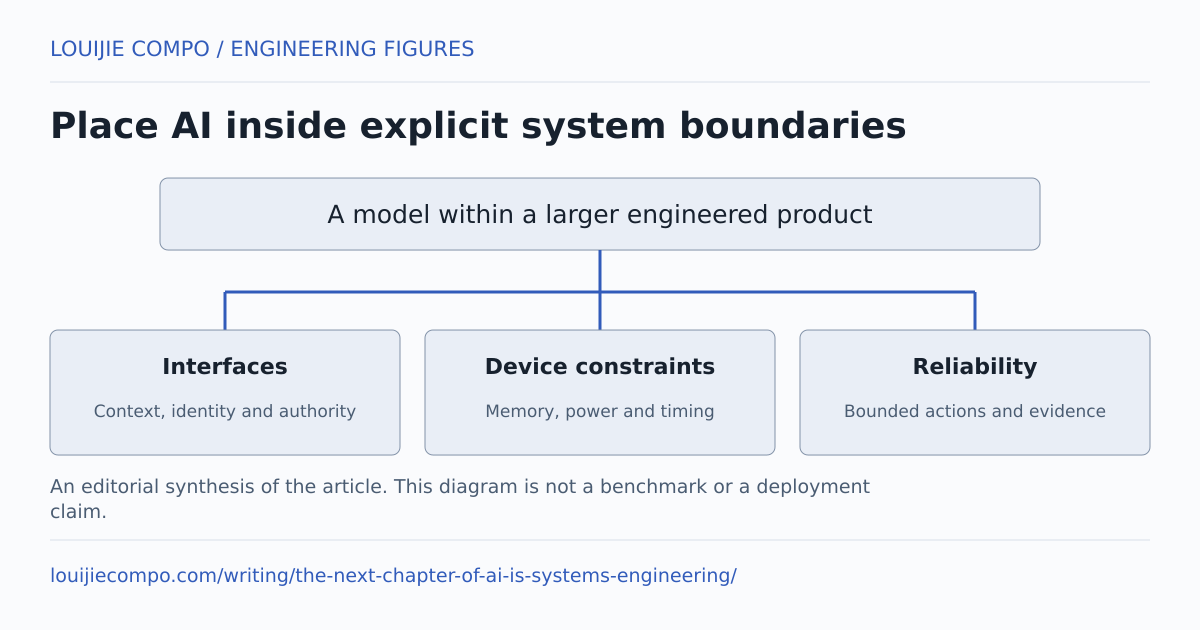
The model is only one part
When I look at the AI developments that have stayed with me this year, they are not model rankings or launch demos. I keep coming back to the work happening around the model: how agents identify themselves, find tools, exchange context, ask for authority, and work with other systems.
In February, the US National Institute of Standards and Technology announced an AI Agent Standards Initiative (opens in a new tab) focused on interoperability, security, identity, and open protocols. The Linux Foundation has also reported broad organizational adoption of the Agent2Agent protocol (opens in a new tab), alongside the Model Context Protocol.
I read these developments as a sign that AI is settling into the same engineering reality as every other useful technology. A model can be impressive on its own and still be difficult to place inside a dependable product. The surrounding contracts matter. Identity, permissions, data ownership, and failure handling need to be clear enough for people to inspect and test.
That is familiar territory. Good systems depend on parts that can work together without hiding their assumptions.
On-device AI brings engineering back into view
I am also interested in the movement of generative AI toward local devices. In May, Google introduced an AI Edge Portal for benchmarking models across more than 120 Android device types (opens in a new tab). It measures initialization time, prompt processing, token generation, and peak memory.
I like this direction because it brings the physical side of the system back into the conversation. Memory, power, latency, heat, connectivity, and privacy directly affect what a person experiences. They are not details to solve after the model is chosen.
This is where my interest in physical systems, embedded software, connected platforms, and applied intelligence comes together. A useful feature has to make the whole trip from a sensor or interface, through software and communications, to a decision or action. Each boundary can add delay, lose context, or change who is responsible for the result.
Putting inference closer to the device does not remove those questions. It makes them easier to see and more important to answer.
Reliability is what makes the feature real
A 2026 study, Towards a Science of AI Agent Reliability (opens in a new tab), found that improvements in task accuracy produced much smaller improvements in reliability. The researchers argue that agents should also be evaluated for consistency, robustness, predictability, and safety.
I find that distinction useful. A feature that works once in a demonstration is different from one that people can depend on. I want evidence to stay close to the behavior it supports. I want actions to have clear limits, failures to be visible, and responsibility to remain understandable when several components are involved.
This is why I see AI as part of systems engineering, not a category apart from it. The interesting work is not simply adding a model. It is deciding where intelligence belongs, defining how it interacts with the rest of the system, and carrying that design into an implementation that remains useful after the demonstration is over.